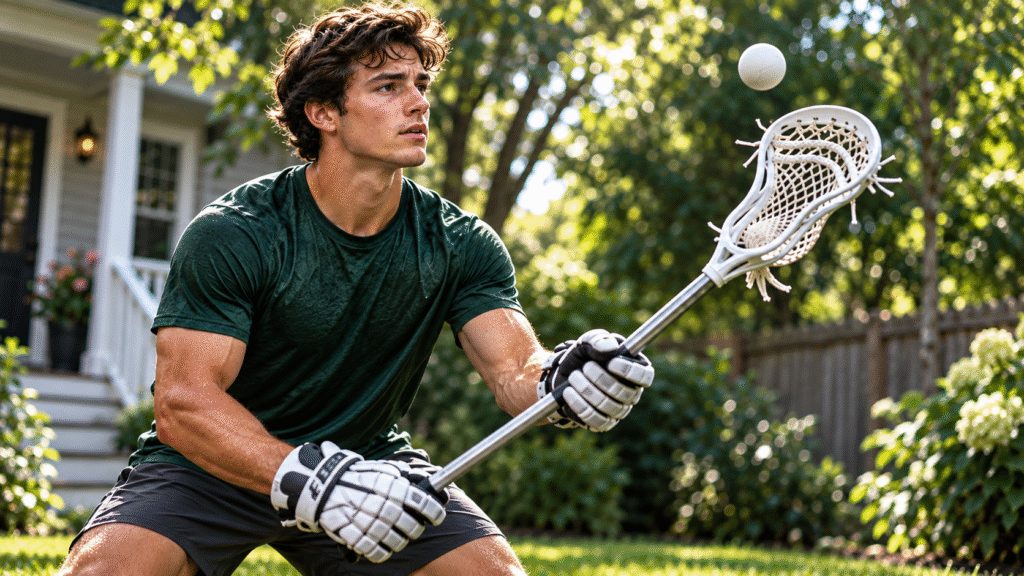
Lacrosse solo training improves your stick skills, shooting accuracy, ground ball technique, and footwork through focused drills you can perform without teammates.
Start with a stick, a ball, and a safe practice area, then build a routine around controlled repetitions with both hands.
A wall or rebounder helps with passing and catching, but neither is essential for every exercise.
A purposeful 30-minute session can combine a warm-up, stickwork, movement, and one measurable challenge.
Whether you are learning the basics or adding work between team practices, your Lacrosse skills training should develop reliable skills that hold up when the game speeds up.
Set Up Your Lacrosse Solo Training Equipment and Space
Your practice setup should match the skills you want to develop. A small backyard can support cradling and footwork; shooting requires more clearance and reliable ball containment.
Essential equipment for practicing alone
Start with:
- Your playing stick: Use the stick appropriate for your discipline and position
- A few balls: Regulation balls provide familiar handling; softer practice balls can suit some controlled exercises
- Two to four markers: Cones or flat markers define movement lanes
- A timer: Keep each practice block focused
- A notebook or phone: Record results and occasional technique videos
Optional Lacrosse solo training equipment includes a rebounder, goal, and a backstop designed for ball containment. Expensive equipment is unnecessary if your available space lets you practice essential Lacrosse skills.
Choose a suitable practice area
Inspect the surface for holes, loose objects, and slippery patches. For wall work, choose a solid, windowless surface where throwing is permitted, with no pedestrians in the rebound area.
A shared courtyard in Chicago calls for different drills than an open field in Maryland. Adapt to the space: controlled stickwork in confined areas, longer movement patterns where clearance allows.
Wear the protective equipment appropriate to your activity and discipline. A softer ball still requires a clear practice area.
Build Stick Skills With Lacrosse Wall Ball Drills
Passing, catching, and cradling deserve regular attention. USA Lacrosse includes wall ball among its foundational learning activities for players practicing independently.
A simple wall ball progression
Stand far enough away to receive a manageable rebound. Use controlled overhand throws and work through:
- Strong-hand passing: Complete 15–20 accurate throws and controlled catches
- Weak-hand passing: Repeat at a pace that preserves technique
- Catch, switch, throw: Secure the ball before changing hands
- Catch and reposition: Take a small lateral step, reset, and pass again
Aim at a consistent spot. Receive the ball with some give rather than holding the stick rigidly. If repeated drops occur, slow down or adjust your distance.
These Lacrosse wall ball drills should build control before speed.
How to improve your weak hand in Lacrosse by yourself
Begin your stickwork block with your weaker hand while your attention is fresh. Practice manageable sets, then compare both sides.
Look for specific differences:
- Does your weaker hand release the ball inconsistently?
- Do you cradle excessively before throwing?
- Does your stick drift across your body?
Choose one correction per set. More repetitions help only when you are reinforcing the movement you want.
How to practice Lacrosse alone without a wall
Use Lacrosse stick handling drills such as walking while cradling, controlled hand changes, and low self-tosses into your stick.
For solo Lacrosse drills for beginners at home, start stationary, then add a few steps. Keep tosses low and predictable.
These exercises develop control, but they cannot fully replace receiving passes from different distances and angles.
Practice Ground Balls, Footwork, and Dodging Alone
Stationary stickwork is only part of the game. Add movement so you can handle the ball while changing direction and recovering possession.
Lacrosse ground ball drills with an exit
Place a ball several steps ahead:
- Approach under control
- Bend through your knees and hips
- Lower the stick head and scoop through the ball
- Bring the stick into a protected carrying position
- Move toward an exit marker with your eyes up
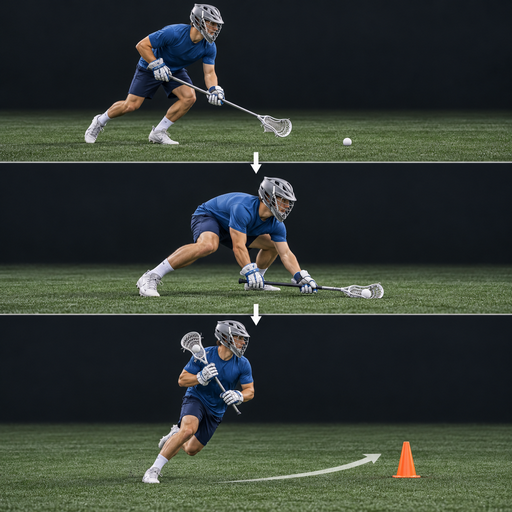
Practice approaching from both sides. Then roll the ball gently ahead to create a moving pickup.
Lacrosse ground ball drills become more useful when possession leads into another action. Alternate exits to the left and right instead of stopping immediately after every scoop.
Lacrosse footwork drills for controlled direction changes
Place two markers several yards apart. Move between them using:
- Lateral shuffles
- Forward approaches followed by controlled stops
- Diagonal cuts
- Short accelerations after changing direction
First learn the pattern without a ball. Then carry your stick and maintain control while moving.
When practicing Lacrosse footwork drills in a small backyard, shorten the distances and emphasize balance. Do not attempt full-speed cuts where you cannot safely slow down.
How to practice Lacrosse dodging without a defender
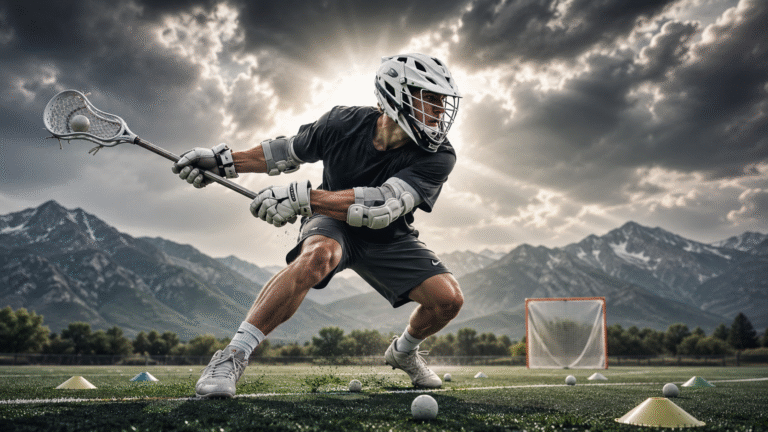
Treat a cone as a defender’s starting position. Approach, change direction, protect your stick, and accelerate into open space.
Begin with a split dodge or simple face dodge. Practice both directions and avoid finishing directly in front of the marker.
A cone teaches the movement pattern; a live defender teaches timing and reactions. Use solo repetitions to prepare for that next step.
Develop Shooting Mechanics and Game Situations
Shooting practice should connect your feet, body rotation, and stick movement. Start with repeatable technique before adding power.
Lacrosse shooting drills alone with a goal
Choose one target area and take a small set of controlled shots. Retrieve the balls, review the results, and repeat.
Progress through:
- Set shots: Establish balance and a consistent release
- Step-in shots: Add a controlled approach
- Dodge-to-shot repetitions: Connect a direction change to your shooting setup
Practice from both sides. USA Lacrosse’s basic shooting instruction emphasizes stepping toward the goal, rotating, and following through.
Use adequate ball containment and keep the entire shooting area clear.
How to practice Lacrosse shooting without a goal
A purpose-built catching net with a suitable backstop can provide a target without a regulation goal.
If you lack safe containment, rehearse the motion without releasing a ball:
- Set your feet
- Move through the shooting action slowly
- Finish balanced
- Reset before the next repetition
Dry repetitions help you inspect mechanics, but they do not measure shooting accuracy. Avoid using fences, household walls, or improvised hanging sheets as high-speed shooting targets.
How to practice Lacrosse game situations alone
Combine skills into short sequences:
- Scoop → look up → carry into open space
- Catch a Lacrosse ball from a rebounder → reposition → pass
- Approach a cone → dodge → prepare a shot
- Carry → change direction → switch hands
A random audio cue can prompt a left or right exit. This introduces an unpredictable instruction, although it does not recreate reading opponents.
Solo training supports game preparation; teammates and defenders remain essential for learning spacing, pressure, and decisions.
Create a Lacrosse Solo Practice Plan You Can Measure
Give every workout a primary objective. “Improve weak-hand passing accuracy” is more useful than “practice everything.”
How to structure a 30-minute solo Lacrosse workout
Use this adaptable Lacrosse solo practice plan:
| Time | Practice block | Main objective | No-wall or no-goal alternative |
|---|---|---|---|
| 0–5 minutes | Progressive warm-up | Prepare for movement | Walking, easy jogging, controlled cuts |
| 5–13 minutes | Passing and catching | Control with both hands | Low self-tosses and hand changes |
| 13–19 minutes | Ground balls and exits | Secure possession while moving | Short pickups into marked lanes |
| 19–26 minutes | Dodging or shooting | Connect movement to an action | Cone dodges or dry shooting mechanics |
| 26–30 minutes | Controlled challenge and log | Measure one skill | Repeat a standard control test |
Include retrieval time and brief rests within each block. If technique deteriorates, reduce the difficulty instead of rushing.
How to track progress in solo Lacrosse training
Choose two or three repeatable measures:
- Controlled catches out of 20 attempts with each hand
- Clean pickups out of 10 ground balls
- Target hits out of 10 controlled shots
- Successful dodge sequences without losing possession
Use the same distance, target size, and drill conditions when comparing results. A weekly video can reveal movement changes that your scores miss.
Increase one challenge at a time: movement, distance, pace, or precision.
FAQ: Lacrosse Solo Training and Practicing Alone
How often should I practice Lacrosse on my own?
As a starting point, try two or three short sessions weekly alongside your team schedule. Adjust for age, experience, fatigue, and other training. Keep extra work lighter during demanding practice or competition weeks.
Can Lacrosse beginners improve without a rebounder?
Yes. Beginners can develop cradling, hand changes, ground ball technique, and footwork without one. A suitable wall or practice partner adds passing and catching opportunities when available.
Can I practice Lacrosse indoors?
Use controlled cradling, hand changes, or slow footwork only where you have sufficient clearance. Avoid hard-ball throwing and shooting in household rooms. Indoor practice facilities provide more suitable options during New York winters.
Should solo practice differ for men’s and women’s Lacrosse?
Shared fundamentals remain valuable, but use your actual playing equipment and adapt drills to your discipline. Pocket characteristics, stick protection, and permitted contact affect how skills transfer into games.
Is solo Lacrosse training enough to become game-ready?
No. It builds individual skills, but games require communication, opponent awareness, and decisions under pressure. Combine independent work with coached practices, partner drills, and competitive play.
Takeaway: Make Lacrosse Solo Training Count
Effective Lacrosse solo training gives every repetition a purpose.
Choose a safe space, work with both hands, and connect stick control to ground balls, footwork, dodging, and shooting. Use a manageable 30-minute routine rather than an unstructured marathon, and track a few consistent measures so improvement becomes visible. Adapt exercises to your available space and equipment, including a Lacrosse stick suited to your discipline and position, while recognizing that live opponents provide challenges you cannot reproduce alone.
Across the USA, whether in a backyard or on a practice field, progress starts with focused work. Grab your stick, set today’s target, and make the next rep count!
Ready to unlock your full potential ?