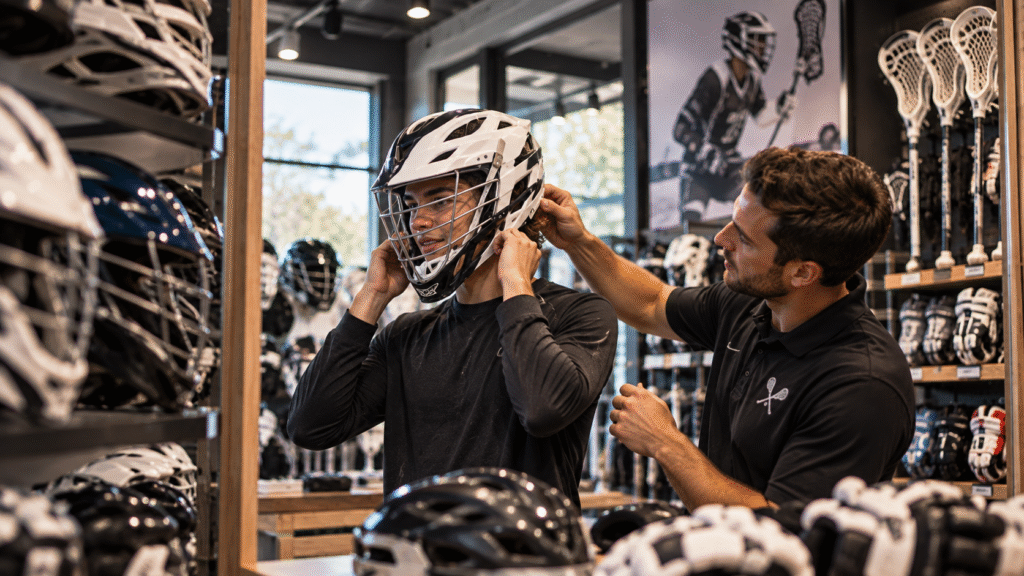
A good Lacrosse helmet meets the required safety standard, fits your head now, and stays in place when you move. Start by choosing a helmet for your version of the game. Measure your head, check the manufacturer’s size chart, and try it on with every strap fastened.
The helmet should feel snug all around, without painful pressure or a blocked view. Price and appearance matter less than getting that fit right. Whether you’re buying Lacrosse gear for a young player or replacing your own helmet, the checks below will help you make a confident choice.
How to Choose a Lacrosse Helmet for Your Game
First, identify the player’s game and position. Equipment requirements differ between boys’ and girls’ Lacrosse, and between field players and goalies.
Boys’ field players wear helmets. Girls’ field players generally use different protective equipment, while goalies in both games wear helmets with face protection. Check your league’s current rules before buying.
Youth vs adult Lacrosse helmets
Should a young player buy a youth or adult model? Choose the one that fits their current head size and shape.
- Measure the player’s head
- Check the size range for the specific model
- Try it on with the straps fastened
- Make sure the shell stays stable during movement
A youth label does not guarantee a better fit for every child. Likewise, an adult helmet is not automatically too large for a teen.
Do not buy extra room for growth. If a helmet slides today, it is too loose today. The chin strap cannot make an oversized shell fit properly.
Field players and goalies
Goalies need a helmet and face mask suited to their position, along with the separate throat protection required by the applicable rules. A field player’s helmet does not become a complete Lacrosse goalie gear setup simply because it has a face mask.
Check that the helmet and face protector are compatible as supplied or approved by the manufacturer. Avoid swapping parts without confirming that compatibility.
Lacrosse Helmet Sizing Guide: Measure and Check the Fit
How do you measure your head for a Lacrosse helmet? Wrap a flexible tape around the widest part of your head, just above your eyebrows and ears. Keep it level, note the measurement, and compare it with the size chart for the specific helmet model.
No flexible tape? Wrap a string around your head, then measure the string against a ruler.
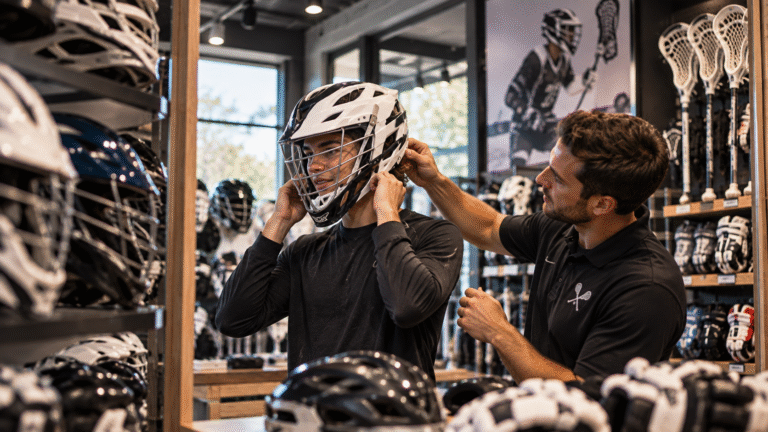
Your measurement is the starting point for proper Lacrosse equipment sizing. Trying the helmet on is the deciding step: two models with similar size ranges may press on different parts of your head.
What proper Lacrosse helmet fit feels like
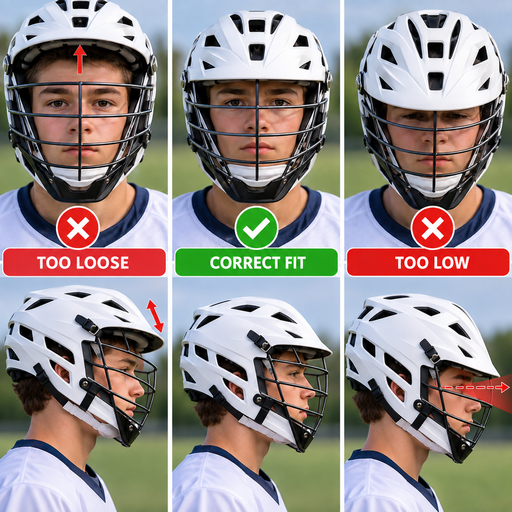
Fasten the chin strap, then check for these signs:
- Padding touches your head all around, with no obvious gaps
- The helmet stays in place when you turn or shake your head
- It sits in the position specified by the manufacturer
- It does not create a painful spot on your forehead or temples
- The face mask does not drop into your sightline
- The chin strap sits on your chin and is properly secured
How tight should a Lacrosse helmet fit? Snug enough to remain stable, but never painfully tight. Wear it for several minutes in the store if you can. Pressure that seems minor at first may become uncomfortable before practice even starts.
A quick fit check
| What you notice | Likely issue | Next step |
|---|---|---|
| Helmet slides when you turn your head | Too much room | Refit it or try another size |
| Pain at the forehead or temples | Pressure concentrated in one spot | Adjust as directed or try another model |
| Face mask drops into your view | Helmet position or fit | Recheck the size and setup |
| Strap feels tight but shell still moves | Shell is too loose | Try a better-fitting helmet |
| Helmet stays stable and feels evenly snug | Promising fit | Check visibility and comfort |
If you’re shopping online, confirm the return terms before buying. A size chart helps, but it cannot tell you how a particular shell will feel on your head.
Lacrosse Helmet Adjustment and Safety Certification
Once you have the right size, follow the manufacturer’s instructions for that model. Adjustment systems vary. Make one small change at a time, fasten the helmet, and repeat the movement check.
How to adjust a Lacrosse helmet chin strap
The strap should help keep an already well-fitting helmet in place.
- Center the chin cup or strap on your chin, as the manufacturer directs
- Secure every required attachment point
- Tighten the straps evenly
- Turn your head, open your mouth, and take a few quick steps
- Readjust if the helmet shifts
For a four-point chin strap, the CDC advises fastening and tightening all four straps during fitting.
If the strap becomes uncomfortable before the shell feels stable, go back to the size and shape of the helmet.
What safety label should you check?
Look for a label that says “MEETS NOCSAE Standard” on a helmet intended for Lacrosse. USA Lacrosse advises buyers to check for that statement; NOCSAE maintains the performance standard for newly manufactured Lacrosse helmets with faceguards.
Then inspect the helmet itself:
- Is the shell free of visible damage?
- Is the face mask secure and undamaged?
- Are the straps, fasteners, and padding intact?
- Are the relevant labels present and readable?
A safety label is essential when choosing Lacrosse protective equipment, but it does not mean a helmet can prevent every injury or concussion. Fit and condition still matter.
Lacrosse Helmet Comfort, Ventilation, and Visibility
A helmet can pass the first fit check and still feel wrong after a few minutes. Before choosing one, give yourself time to move and look around while wearing it.
Check comfort and ventilation
Put the helmet on and imagine a short sequence of play:
- Turn quickly toward a teammate calling for a pass
- Look down as though scooping a ground ball
- Look up as though catching a high pass
- Hold a ready position for a minute or two
Does the helmet stay put? Does pressure build anywhere? Can you concentrate on the imagined play instead of the padding?
Ventilation can make a difference during a humid New York tournament or an afternoon practice in Texas. Compare how suitable models feel, but keep fit first on your checklist. A cooler-feeling helmet that shifts around is the wrong choice.
Test Lacrosse helmet facemask visibility
With the helmet properly fastened, look:
- Straight ahead
- To your left and right
- Down toward the ground
- Up toward an imagined high ball
The face mask will be visible to some degree. Watch for bars or a slipping helmet position that make it difficult to follow the ball.
Goalies should spend extra time on this check. From your usual ready stance, have someone move a ball across your field of view. You should be able to track it without repeatedly tilting your helmet.
Buying Your First Helmet and Keeping It Game-Ready
How much should you spend on your first Lacrosse helmet? Spend enough to get an appropriate, standard-compliant helmet that fits well. There is no universal dollar amount: prices change, and a more expensive model is not necessarily a better match for your head.
If your budget is limited, ask a local program about equipment options. Apply the same fit and condition checks to any helmet you consider.
A simple buying checklist
Before paying, confirm:
- Game and position: Is this the right setup for the player?
- Size: Does the head measurement fall within this model’s range?
- Label: Does the helmet carry the Lacrosse NOCSAE statement?
- Fit: Does it stay stable with all straps fastened?
- Comfort: Are there pressure points after several minutes?
- Visibility: Can the player follow the ball comfortably?
- Goalie gear: Is the required separate throat protector included in the setup?
Whether you shop in Chicago, Los Angeles, or online, use the exact model’s instructions and size chart.
Check it before every game
A brief inspection can catch a problem before you take the field. Look for a cracked shell, bent or loose face mask, damaged straps, or missing and insecure padding.
Clean and store the helmet according to the manufacturer’s instructions. After a significant impact, or if you spot damage, follow the manufacturer’s guidance before using it again.
FAQ: Lacrosse Helmet Fit and Safety Questions
How can I tell if a Lacrosse helmet is too big?
It slides when you turn your head, leaves gaps around the padding, or needs an uncomfortably tight chin strap to stay in place. Try the approved adjustments; if it still moves, try another size or model.
Can a Lacrosse helmet fit properly without causing headaches?
Yes. It should feel evenly snug without painful pressure. If it causes a headache, check the adjustment and try a different size or shape.
What should I look for when trying on a Lacrosse helmet?
Check the safety label, padding contact, shell stability, chin strap, sightlines, and comfort after several minutes. Move your head as you would during play.
Does a youth player need a youth or adult Lacrosse helmet?
They need whichever appropriate model fits their head right now. Measure first, consult that model’s size chart, and verify the fit with the straps fastened.
What is the difference between a field Lacrosse helmet and a goalie helmet?
The full goalie setup must meet the requirements for that player’s game and position, including a separate throat protector. Check your league’s rules and the manufacturer’s approved helmet setup before moving a field helmet into the goal.
Takeaway: Find a Lacrosse Helmet That Fits and Stays Put
Start with the right equipment for your game, then check the Lacrosse safety label and measure your head. Try the helmet on with every strap fastened. It should stay stable when you move, feel snug without pain, and let you see the play clearly.
Compare ventilation and comfort among helmets that pass those checks. Inspect your helmet regularly and follow the manufacturer’s care instructions; for parents, these checks are also part of keeping youth Lacrosse safe. A good fit lets you spend less time thinking about your gear and more time reading the field. Gear up, get moving, and play your game!
Ready to unlock your full potential ?