
A Lacrosse team normally has 10 players on the field in men’s field Lacrosse, 12 in US women’s school and college field Lacrosse, and six in Box or Sixes Lacrosse. Those totals include the goalie.
International women’s field Lacrosse uses 10 players, while youth formats vary by age and league.
The key distinction is players in the game versus players on the roster: substitutes belong to the team but do not all play at once.
Whether you’re registering a child, watching college competition, or following Team USA, understanding Lacrosse basics such as playing formats and team sizes makes the action much easier to follow.
How Many Players Are on a Lacrosse Team by Format?
“Team size” can describe the starting lineup, everyone dressed for a game, or an entire season roster. Start with the number allowed in play.
| Lacrosse format | Players per team in play | Standard breakdown | Both teams combined |
|---|---|---|---|
| Men’s field Lacrosse | 10 | 9 field players + 1 goalie | 20 |
| Women’s field Lacrosse (US high school and college) | 12 | 11 field players + 1 goalie | 24 |
| Women’s field Lacrosse (international rules) | 10 | 9 field players + 1 goalie | 20 |
| Box Lacrosse | 6 | 5 runners + 1 goalie | 12 |
| Sixes Lacrosse | 6 | 5 field players + 1 goalie | 12 |
| Youth Lacrosse | Varies | Age- and league-specific | Varies |
These are full-strength playing numbers, rather than roster limits. Women’s domestic and international rules differ, so “women’s Lacrosse always has 12 players” is an incomplete answer.
Does the goalie count as a player in Lacrosse?
Yes—the goalie is included in the team’s playing total. A men’s field lineup has 10 players altogether, rather than 10 outfield players plus a goalkeeper.
Likewise, “six-on-six” normally describes six players on each side, including the goalies.
If you’re wondering how many players are on a Lacrosse field at once including both teams, double the per-team number. Remember that Lacrosse penalties, injuries, and some overtime formats can change the number of players you actually see in play.
Men’s Field Lacrosse Team Size and Positions
The standard men’s field Lacrosse team size is 10 players per side. The traditional lineup includes three attackmen, three midfielders, three defensemen, and one goalie. This is the familiar full-field structure used throughout American boys’ high school and men’s college competition.
How many attackmen and defensemen are on the field in men’s Lacrosse?
A conventional lineup has three attackmen and three defensemen. Their responsibilities differ:
- Attackmen create scoring opportunities through dodges, feeds, cuts, and shots
- Defensemen protect the goal, cover attackers, and disrupt possession
- Midfielders connect offense and defense through transition
- The goalie makes saves and helps organize the defense
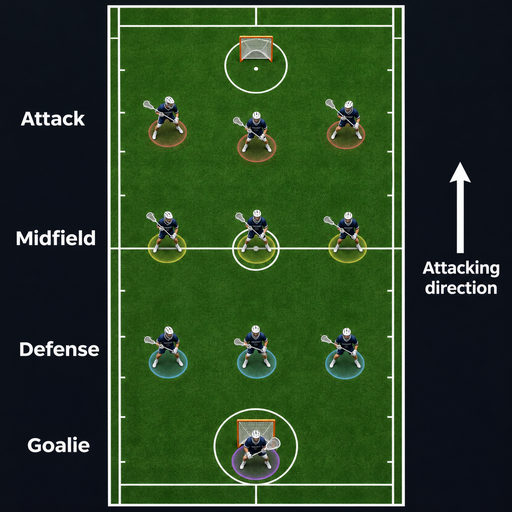
Lacrosse positions define each player’s responsibilities, but substitutions make the lineup more flexible. Coaches can rotate offensive midfielders, defensive midfielders, and specialists into different situations.
That’s why a game may feature many more than 10 athletes from each team over four quarters. The playing limit stays the same while personnel change.
For spectators, watch the midfield substitution area after possession changes. Those exchanges often reveal whether a team wants to push transition or settle into its preferred personnel.
Women’s Field Lacrosse Team Size: US vs. International
Women’s field Lacrosse team size depends on the governing rules. US high school girls’ and NCAA women’s competition generally uses 12 players per team, including the goalie. International women’s field competition uses 10.
The familiar US 12-player lineup
A common US alignment has four attackers, three midfielders, four defenders, and one goalie. Coaches can organize those players differently according to matchups, draw strategy, and transition responsibilities.
A parent watching a high school game should therefore expect a different player count from someone watching an international women’s championship.
The difference also affects space. Fewer players can create different passing windows and defensive decisions, although the Lacrosse field layout and other rules also shape how teams use the space.
Why checking the competition matters
Avoid applying one women’s rulebook to every event. International games, domestic leagues, and experimental college contests may use different structures.
For example, the NCAA approved an option for fall experimentation with 10 players instead of 12 in 2026. That experiment should not be confused with a universal change to the standard college lineup. Check the event’s published rules before assuming its player count.
Box and Sixes Lacrosse Team Size Explained
Box and Sixes both normally put six players per team into action. Their shared headcount can make them look similar on paper, but the playing environment and positional demands create distinct experiences.
Box Lacrosse team size: five runners and a goalie
The standard Box Lacrosse team size is six: five runners and one goaltender. “Runners” means the players who are not the goalie, regardless of whether their current assignment is offensive or defensive. Box is played inside a boarded rink.
So, how many runners are on the floor in Box Lacrosse? Normally five per team at full strength.
Fans watching the Buffalo Bandits in New York or Colorado Mammoth in Denver will see frequent personnel changes as teams manage possession, defensive assignments, and fatigue.
Sixes Lacrosse team size: built around two-way play
Sixes Lacrosse team size is five field players plus one goalie. Under World Lacrosse’s 2026–2028 rules, the active roster can contain up to 12 players, including at least one goalkeeper.
Field players must contribute at both ends, making stick skills, quick decisions, and recovery runs especially valuable.
Sixes Lacrosse is also the format selected for the sport’s return at the Los Angeles 2028 Games. For new USA fans, it offers a compact introduction to elite Lacrosse without the larger traditional field lineup.
Youth Lacrosse Team Size, Rosters, and Substitutions
Youth Lacrosse team size follows developmental needs. Smaller teams give beginners more opportunities to handle the ball, make decisions, and participate meaningfully.
How many players are on a 10U Lacrosse team during a game?
There is no single nationwide answer covering every boys’ and girls’ league.
USA Lacrosse’s 2026 boys’ guidance includes six-on-six and seven-on-seven options at 10U, with a goalkeeper included; its comparison chart also identifies a 10-on-10 option under NFHS rules. The girls’ 10U comparison lists formats ranging from three-on-three through eight-on-eight with a goalkeeper. Confirm the specific format with your program.
A recreation program and a travel tournament may therefore use different numbers for similarly aged children.
Lacrosse roster size: how many substitutes should youth teams have?
Lacrosse roster size includes starters and substitutes. The right number depends on playing format, attendance, game length, and participation goals.
As a practical planning example—not an official requirement—a seven-player lineup with four substitutes gives a coach 11 available athletes. That provides rotation options without requiring an enormous bench.
Before registering, ask:
- How many players are expected at each game?
- How will playing time be shared?
- Is there a trained backup goalie?
- How many games might the team play in one day?
Lacrosse substitution rules and live changes
Can Lacrosse teams substitute players without stopping play? Yes, on-the-fly substitutions are allowed in major formats, subject to the applicable entry, exit, and substitution-area rules.
For example, World Lacrosse Sixes requires the departing player to leave the field before the replacement enters.
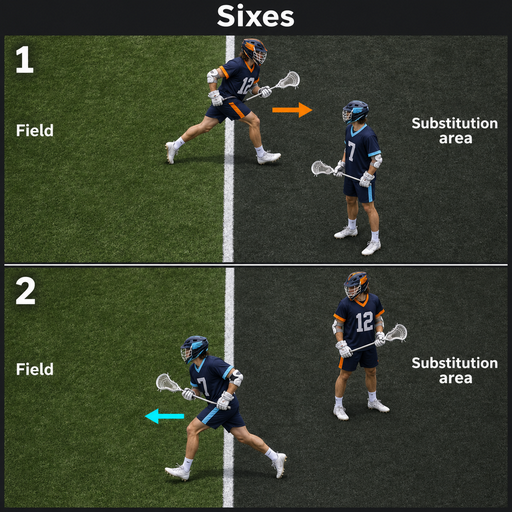
Learning the exchange procedure matters as much as knowing the lineup limit: an incorrect change can create an illegal extra player.
FAQ: Lacrosse Team Size, Goalies, and Penalties
What is the minimum number of players needed to start a Lacrosse game?
The minimum depends on the format and governing rules. World Lacrosse Sixes requires six players, including a legally equipped goalkeeper, to start. Don’t assume that permission to continue shorthanded also permits starting shorthanded; check your competition’s rulebook.
Can a Lacrosse team replace its goalie with an extra attacker?
Some formats permit pulling the goalie for an extra attacker, subject to their rules. However, World Lacrosse Sixes requires a legally equipped goalkeeper on the field at all times. Pulling a goalie never increases the team’s permitted total number of players.
Does a Lacrosse team play with fewer players after a penalty?
Often, but not after every foul. Time-serving penalties can create shorthanded situations. Youth exceptions matter: USA Lacrosse’s boys’ small-sided 10U guidance allows the penalized player to serve while the team remains at full strength; its 10-on-10 option follows different provisions.
Why are there more Lacrosse players on the bench than on the field?
The bench holds substitutes and reserves. Coaches rotate players to manage fatigue, adjust matchups, and cover specialized responsibilities. The full roster may be much larger than the lineup, but only the permitted number can participate simultaneously.
Do all youth Lacrosse teams eventually play 10-on-10?
No. Ten-on-ten is the traditional older boys’ field format, while US girls’ school field competition generally uses 12-on-12. Players may also continue in Box, Sixes, or other small-sided programs. Age alone doesn’t identify the format.
Takeaway: Know Your Lacrosse Format Before Counting Players
The clearest answer starts with the competition: 10 for men’s field, 12 for standard US women’s school and college field, 10 for international women’s field, and six for Box or Sixes. The goalie counts, while substitutes belong to the larger roster.
Youth numbers depend on age and youth Lacrosse rules, so confirm your program’s format before registration or game day.
Understanding these differences helps parents evaluate programs, players prepare for their responsibilities, and fans follow substitutions and matchups.
Know the lineup, understand the rules, and watch the game with confidence. Grab your stick, back your teammates, and bring your best every shift!
Ready to unlock your full potential ?