
The main objective of Lacrosse is to score more goals than the opposing team before the game ends. Players use a Lacrosse stick to catch, carry, pass, and shoot the ball into the opponent’s goal.
Although that sounds simple, winning requires coordinated offense, disciplined defense, possession control, and smart decision-making. Each goal is worth one point, and the team with the higher score wins.
From youth games in Maryland to professional matchups in New York and California, the essential challenge remains the same: create quality scoring opportunities while preventing the other team from scoring.
What Is the Main Objective of Lacrosse?
The objective of Lacrosse combines two responsibilities: scoring on offense and protecting the goal on defense. When a team possesses the ball, it tries to move it into a favorable shooting position. When possession changes, that same team must immediately reorganize to stop the opponent’s attack.
This makes Lacrosse a continuous contest for space, possession, and opportunity. A successful team does more than shoot frequently. It controls where shots come from, limits turnovers, and forces opponents into difficult decisions.
The objective during an offensive possession
On offense, the team attempts to move the ball past defenders and shoot it into the opposing goal. Players may advance the ball by running with it in their stick or passing to teammates.
The offense generally tries to:
- Maintain possession under defensive pressure
- Move defenders out of position
- Create open passing and shooting lanes
- Generate high-percentage shots near the goal
- Recover missed shots when the rules allow
- Avoid turnovers that could start a fast break
A strong offense rarely depends on one player attacking repeatedly. Ball movement, off-ball cuts, screens, and communication force the defense to react. When defenders slide or rotate, another player may become open.
The objective during a defensive possession
The defense must prevent goals while attempting to regain possession. Defenders protect dangerous areas, pressure ball carriers, disrupt passes, and support teammates when an attacker gets beaten.
The goalkeeper provides the final layer of protection, but preventing goals is a team responsibility. Midfielders may need to sprint back after a turnover, while attack-minded players can help by applying pressure during the opponent’s clearing attempt.
The simplest answer to “How do offense and defense work in Lacrosse?” is that offense creates space and defense removes it. The side that manages space more effectively usually produces the better scoring chances.
How Scoring Works in Lacrosse
Understanding how scoring works in Lacrosse begins with one essential rule: the entire ball must legally cross the goal line between the posts and beneath the crossbar. If it does, the attacking team receives one point.
How do you score a goal in Lacrosse?
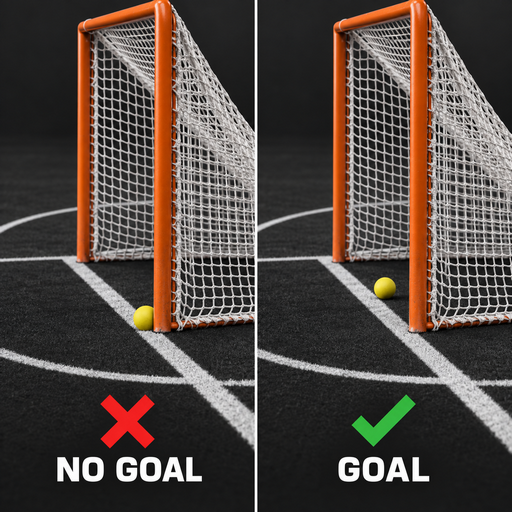
A player scores by shooting the ball from the field of play into the opposing goal. The shot can be overhand, underhand, sidearm, or backhand, provided the player and equipment comply with the rules of that game format.
Goals can result from several situations:
- A settled offensive possession
- A fast break after a turnover
- An extra-player opportunity following a penalty
- A cut toward the goal followed by a quick pass
- A rebound or loose ball near the crease
- A transition initiated by the goalkeeper or defense
Can players score from anywhere on a Lacrosse field? Generally, a legal shot may come from almost any location within the field of play. However, players must respect crease restrictions and other format-specific rules. Long-distance shots are possible, but closer attempts typically offer a better chance of scoring.
How many points is a goal worth in Lacrosse?
A goal is worth one point in standard field Lacrosse, women’s Lacrosse, box Lacrosse, and Sixes. There is no automatic bonus for shooting from farther away in the major standard formats.
Here is a simple comparison:
| Game situation | Point value | What must happen |
|---|---|---|
| Regular field goal | 1 point | The ball legally crosses the goal line |
| Fast-break goal | 1 point | The transition attack ends with a legal goal |
| Extra-player goal | 1 point | The offense scores while holding a player advantage |
| Long-range goal | 1 point | Distance does not change the standard value |
| Overtime goal | 1 point | The goal ends sudden-victory overtime in many formats |
The Premier Lacrosse League has used a two-point arc in its field game, making some long-range goals worth two points. That is a league-specific feature rather than a universal basic rule of Lacrosse. Players and spectators should always check the rules governing the particular league or competition.
Basic Rules of Lacrosse That Shape How Teams Win
The basic rules of Lacrosse determine how teams pursue the same overall objective. Regulations vary among men’s field Lacrosse, women’s field Lacrosse, youth competition, box Lacrosse, and Sixes, but several principles remain recognizable across formats.
What are the basic rules for beginners in Lacrosse?
Beginners should first understand these fundamental concepts:
- Players use the stick—not their hands—to control the ball, except when a goalkeeper makes a legal save or a rule specifically allows contact
- Teams attempt to shoot into the opponent’s goal while defending their own
- Possession can change through interceptions, checks, ground balls, faceoffs or draws, saves, and rule violations
- The crease protects the goalkeeper and restricts how attacking players may enter or interact around the goal area
- Illegal body contact, dangerous stick use, holding, pushing, and other violations can produce penalties
- Teams must obey boundaries, timing rules, and any requirements for advancing or retaining the ball
Contact rules deserve particular attention. Men’s field Lacrosse permits certain controlled body checks for eligible age groups and levels. Women’s field Lacrosse emphasizes stick positioning and controlled checking, with much stricter limitations on body contact. Youth leagues across the USA may modify both contact and checking rules for safety and development.
Possession is the hidden objective
The scoreboard determines the winner, but possession strongly influences the result. A team cannot score without creating offensive opportunities, and every careless turnover gives the opponent another chance.
Winning teams value possession by:
- Securing faceoffs or draws
- Winning ground-ball contests
- Completing efficient clears
- Protecting sticks from legal checks
- Making accurate passes
- Backing up shots
- Managing the ball late in a close game
This is why a ground ball in a high school game or a successful clear in a college matchup can matter almost as much as a spectacular goal. Both actions extend possession and influence which team controls the next phase of play.
How to Win a Lacrosse Game Through Positions and Strategy
How does a team win a Lacrosse game? It finishes with more points than its opponent, but consistently achieving that result requires a complete Lacrosse game strategy. Teams must connect individual skills with coordinated positional play.
Lacrosse player positions and roles
What does each position do in Lacrosse? The exact lineup depends on the format, but traditional field Lacrosse generally divides responsibilities as follows:
| Position | Primary responsibility | Contribution to winning |
|---|---|---|
| Attack | Create and finish scoring opportunities | Feeds, shoots, cuts, and protects possession |
| Midfield | Play across offensive and defensive phases | Supports transition, ground balls, and matchups |
| Defense | Stop attackers and recover the ball | Protects high-value areas and disrupts possession |
| Goalkeeper | Defend the goal and direct the defense | Makes saves, communicates, and begins clears |
| Faceoff specialist or draw player | Compete for possession after starts and goals | Creates additional offensive opportunities |
Roles can be more specialized at advanced levels. A college program might use short-stick defensive midfielders, long-stick midfielders, faceoff specialists, and offensive midfield units. Youth teams may keep roles simpler so players learn the entire game.
The strategic formula for winning
Effective teams usually perform well in five interconnected areas:
- Possession: Win faceoffs, draws, rebounds, and ground balls
- Shot quality: Create open attempts rather than settling for low-percentage shots
- Transition: Move quickly after gaining possession and recover immediately after losing it
- Defense: Communicate, slide correctly, and protect the center of the field
- Discipline: Limit penalties, rushed passes, and preventable turnovers
Game context also matters. A team leading late may favor longer possessions and safer passes. A trailing team may increase defensive pressure and attack earlier. Coaches in major Lacrosse regions such as Maryland, New York, and Pennsylvania frequently emphasize situational awareness because the correct decision changes with the score and remaining time.
Individual talent can win a matchup. Team coordination wins possessions repeatedly, which is far more valuable across an entire game.
Lacrosse Game Length, Overtime, and Different Formats
Lacrosse game length and overtime rules depend on the players’ age, competition level, league, and format. Games are normally divided into timed periods, but quarter or half lengths are not identical across youth, high school, college, professional, and international competitions.
Teams therefore need to verify the official rules used for their event rather than assuming every Lacrosse game follows one universal clock.
What happens when a Lacrosse game ends in a tie?
Many competitions use sudden-victory overtime. Play continues through one or more additional periods until a team scores, immediately ending the game. Tournament organizers or youth leagues may instead allow ties, use shortened overtime, or apply competition-specific procedures.
Overtime changes strategic priorities. One lost possession can end the game, so teams may favor controlled offense, safer substitutions, and their most reliable defensive matchups. Faceoffs, draws, ground balls, and goalkeeper clears become especially important because the next possession may be decisive.
Field Lacrosse vs Sixes objectives
The Field Lacrosse vs Sixes objectives are fundamentally the same: outscore the opponent. The way teams pursue that objective, however, is noticeably different.
Traditional field Lacrosse uses a larger field, more players, and greater positional specialization. Sixes features six players per team, a smaller field, a shorter possession clock, and faster transitions. Players switch between attacking and defending more frequently, leaving less time for deliberate substitutions or extended offensive setups.
Is the objective different in men’s and women’s Lacrosse? No. Both aim to score more goals than the opposition. Differences in field markings, protective equipment, checking, draws or faceoffs, player numbers, and specific restrictions change the method—not the ultimate objective.
That distinction will be especially visible when Lacrosse returns to the Olympic stage at Los Angeles 2028 through the Sixes format. The game will still reward scoring and defense, but speed, versatility, and rapid decision-making will be central to winning.
FAQ: Understanding the Objective and Rules of Lacrosse
What is the main objective of Lacrosse?
The main objective is to score more goals than the opposing team while preventing it from scoring. Teams use passing, carrying, shooting, defense, and possession management to achieve that result.
How is a goal scored in Lacrosse?
A goal is scored when a legal shot sends the entire ball across the goal line, between the posts, and beneath the crossbar. Crease violations, penalties, or an expired clock can cause an apparent goal to be disallowed.
How many points is a goal worth in Lacrosse?
A goal is normally worth one point. Certain professional rules may award additional points for designated long-range shots, but that system does not apply to every league or Lacrosse format.
How does a team win a Lacrosse game?
A team wins by having more points when regulation or overtime ends. Strong teams improve their chances through possession, high-quality shooting, defensive communication, effective transition play, and disciplined decision-making.
What happens when a Lacrosse game ends in a tie?
Many leagues proceed to sudden-victory overtime, in which the first team to score wins. Some youth leagues and tournament formats may permit ties or use different overtime procedures, so the applicable rulebook should be checked.
Takeaway: How the Objective of Lacrosse Leads to Victory
The objective of Lacrosse is to outscore the opposing team, but winning involves much more than shooting the ball. Teams must secure possession, create high-quality chances, defend dangerous spaces, manage transitions, and adapt to the score and clock. Each standard goal is worth one point, while positions and rules vary among men’s, women’s, youth, field, box, and Sixes Lacrosse.
Once beginners understand how scoring, possession, and teamwork connect, the game becomes much easier to follow and play. Control the ball, trust your teammates, attack with purpose, and defend every possession—then play to win!
Ready to unlock your full potential ?