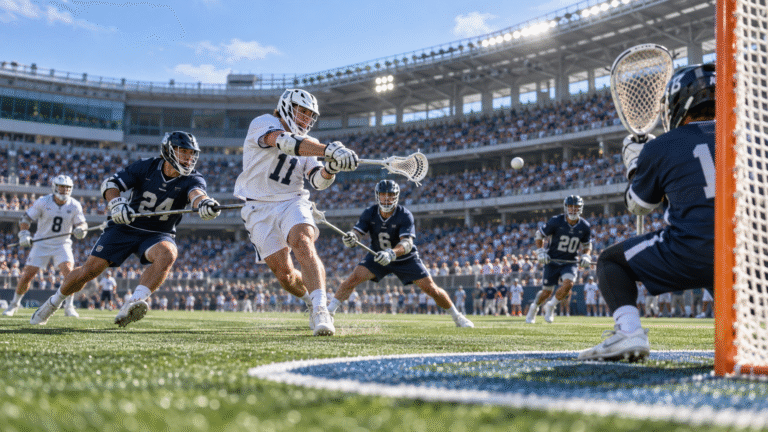
A Lacrosse field layout includes boundary lines, midfield markings, restraining lines, goals, and protected circles around each goal. Together, these markings show where play happens, where players start, and which movement restrictions apply.
A standard men’s field measures 110 yards long by 60 yards wide, while women’s fields use different dimensions and distinctive scoring-area markings. Understanding those differences helps players position themselves, parents follow the action, and coaches explain the game.
This guide breaks down the outdoor field used across the USA, from the center faceoff area to the space behind the net, with practical explanations for beginners.
Lacrosse Field Dimensions: Men’s vs. Women’s Layouts
Before learning individual lines, identify which version of the game you’re watching. A men’s vs. women’s Lacrosse field comparison involves more than size: the markings support different positioning and restart rules.
This guide covers traditional outdoor field Lacrosse. Box and Sixes use different layouts.
Standard Field Measurements
| Feature | Men’s Field Lacrosse | Women’s Field Lacrosse |
|---|---|---|
| Field length | 110 yards | NCAA permitted range: 110–120 yards |
| Field width | 60 yards | NCAA permitted range: 60–70 yards |
| Goal opening | 6 feet wide × 6 feet high | 6 feet wide × 6 feet high |
| Protected goal area | Crease with a 9-foot radius | Goal circle with an 8.5-foot radius |
| Distinctive markings | Wing lines and rectangular attack areas | Center circle, 8-meter arc, and 12-meter fan |
The NCAA women’s rulebook identifies approximately 120 by 65 yards as optimal, with alternatives permitted where space is limited. Youth programs may use smaller fields and modified formats, so check your league’s diagram before measuring a practice field.
Why the Space Behind the Goals Matters
On a standard men’s field, each goal sits 15 yards inside its end line. That leaves playable space behind the net—a major difference from sports where the goal sits directly on the boundary.
For a beginner, the useful lesson is simple: reaching the goal line does not mean reaching the end of the playing area.
How to Read Lacrosse Field Markings
Learning how to read a Lacrosse field diagram becomes easier when you work from the outside inward.
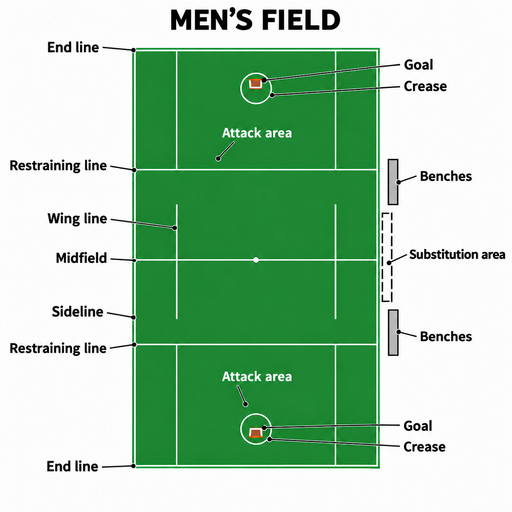
Start with the rectangle, locate midfield, identify both goals, and then examine the markings around them. Leave bench-side details until last.
Boundary Lines, Midfield, and Goal Line Extended
These landmarks provide your basic orientation:
- Sidelines: The two long boundaries
- End lines: The boundaries behind the goals
- Midfield line: The line dividing the field into two halves
- Goal lines: The lines across the goal openings
- Goal line extended, or GLE: An imaginary extension of each goal line toward both sidelines
GLE is especially useful in coaching. “Carry above GLE” tells an attacker to move from behind the goal into a position level with or beyond its opening.
Unlike a painted boundary, GLE is a reference point. Crossing it does not automatically cause a violation.
A Simple Diagram-Reading Routine
Before your first practice or game:
- Find the goal your team is defending
- Identify the opposite goal as your attacking direction
- Locate midfield and the restraining lines
- Find the crease or goal circle
- Locate the substitution area beside the benches
On a shared football or soccer field, ask which line color belongs to Lacrosse. Following the wrong markings can make an otherwise straightforward layout confusing.
Lacrosse Field Zones and Restraining Lines
Coaches commonly describe three Lacrosse field zones: the defensive end, midfield, and the attacking end.
Those descriptions depend on your team’s direction. The same patch of turf is one team’s attacking end and its opponent’s defensive end.
What Do Lacrosse Restraining Lines Do?
On a standard men’s field, restraining lines sit 20 yards from midfield on either side. Along with additional markings near each goal, they help define the attack areas and control positioning during faceoffs.
Think of the zones by their practical jobs:
- Defensive end: Protect the goal and begin clearing the ball
- Midfield: Connect defense and offense during transitions
- Attacking end: Create passing lanes and scoring chances
These are useful teaching categories, but players must also understand which specific line governs a rule.
How Do Lacrosse Field Zones Affect Offsides?
Men’s offsides is governed by midfield, rather than simply entering an attack area. In normal full-strength play, a team must keep at least three players in its attacking half and four in its defensive half, including the goalkeeper.
A defender can cross midfield if a teammate stays back to preserve the required numbers. Position names do not permanently lock players into one half.
Women’s Lacrosse uses restraining-line counts instead: normally, no more than seven players from a team may occupy its attacking end, or eight its defensive end, including the goalkeeper. Penalty situations require additional attention.
The Lacrosse Goal Crease and Scoring Areas
The markings around the goal influence shooting, defending, and player safety. Learn these before attempting close-range dodges or defensive pressure near the goalkeeper.
The Crease, GLE, and “X”
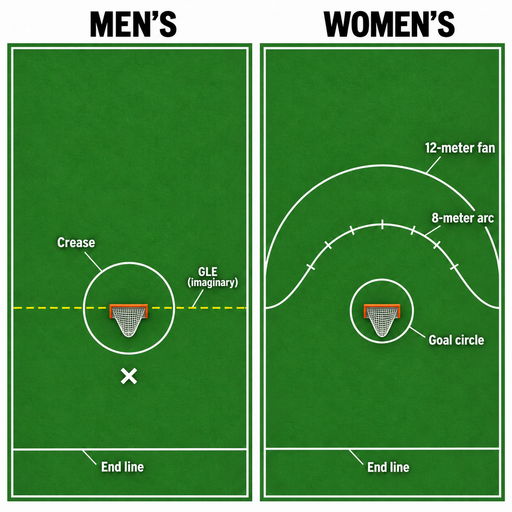
The Lacrosse goal crease is the circle surrounding the men’s goal. The comparable women’s marking is officially called the goal circle.
For beginners, the essential attacking habit is to keep your feet outside the opponent’s protected goal area. Detailed entry, airborne shooting, and goalkeeper-interference rules differ by ruleset. Men’s defensive players can enter their own crease, subject to the applicable rules; it is not exclusively a goalkeeper-only space.
What is the area behind the goal in Lacrosse called? Coaches commonly call the central attacking position behind the net “X.”
X is a tactical location, not another painted box. An attacker there can feed cutters, change the ball’s direction, or dodge toward either side of the goal.
What Is the 8-Meter Arc in Women’s Lacrosse?
The 8-meter arc is the inner curved marking in front of the goal circle. Its hash marks help organize certain free-position opportunities.
For players, it also provides a valuable visual reference when learning attacking spacing and defensive positioning.
What Is the 12-Meter Fan in Women’s Lacrosse?
The 12-meter fan is the larger semicircular marking outside the 8-meter arc.
Both markings relate to rules and positioning around goal. Neither is a two-point line in traditional women’s field Lacrosse. The NCAA construction specifications measure these markings from the goal circle, so avoid assuming their names describe distance from the center of the goal.
Faceoff Positions and the Lacrosse Substitution Area
Two smaller parts of the layout deserve special attention: the midfield starting positions and the bench-side entry area.
Both can affect possession before an offensive play develops.
Where Do Players Line Up for a Lacrosse Faceoff?
In traditional men’s Lacrosse, two opponents contest the ball at the center faceoff spot. Their wing teammates begin in the designated wing areas, while attackmen and defenders remain behind the appropriate restraining lines until released by rule.
What are the wing areas on a Lacrosse field? They are the marked midfield starting areas for players supporting the faceoff.
A wing player should anticipate where a loose ball might travel, rather than simply sprint toward the two players contesting it.
Women’s Lacrosse starts with a draw at center, using its center-circle positioning rules rather than the men’s faceoff setup.
Where Do Players Enter During Lacrosse Substitutions?
Players making routine live substitutions use the designated substitution area near midfield on the bench side.
This is different from the broader team bench area. A player sitting near the attacking end cannot simply step onto the field from that location.
Locate the entry markers before playing, communicate with the teammate you are replacing, and follow your competition’s exchange procedure. Clean substitutions help a team maintain its numbers and avoid preventable violations.
FAQ: Lacrosse Field Layout, Boundaries, and Crease Rules
What happens when the ball goes out of bounds in Lacrosse?
An ordinary pass or loose ball generally goes to the opponent of the team that touched it last. After a shot, possession generally goes to the team with the nearest eligible inbounds player when and where the ball exits. That distinction explains why attackers back up shots.
Can you go inside the crease in Lacrosse?
It depends on your role and ruleset. Goalkeepers use the protected area, and men’s defenders may enter their own crease. Attackers should stay outside the opponent’s crease; specialized shooting and interference situations require the applicable rulebook.
Are all Lacrosse fields the same size?
No. Men’s and women’s outdoor fields differ, and youth formats can use smaller playing areas. Box and Sixes also have separate specifications.
Is the space behind the goal in bounds in Lacrosse?
Yes, until the end line. Players can carry, pass, defend, and recover loose balls behind the goal.
How can beginners learn the Lacrosse field quickly?
Walk the boundaries, find midfield, identify the restraining lines, and locate both protected goal areas. Then find the substitution markers. Connecting each landmark to one action makes the layout easier to remember.
Takeaway: Read the Lacrosse Field and Play With Confidence
Understanding the Lacrosse field layout gives every possession more context. Boundaries define playable space, midfield and restraining lines organize movement, and the crease protects the area around goal. Men’s wing markings and women’s scoring arcs serve different purposes, so always identify your format first.
Before practice, take a quick walk around the field and connect each marking to a real situation: a faceoff, a clear, a substitution, or a shot backed up behind the net.
From New York to Los Angeles, field awareness helps you react with purpose. Learn the lines, trust your preparation, and get after the next play!
Ready to unlock your full potential ?