
In most Lacrosse games, each legal goal adds one point to the team’s score, and the team with the higher score wins. Individual player points usually mean goals plus assists, which is a different total from the scoreboard.
The main exception beginners encounter is the Premier Lacrosse League (PLL), where qualifying shots beyond a marked arc earn two points.
Understanding team scores versus player statistics is one of the Lacrosse basics that makes the game much easier to follow. Whether you’re watching college Lacrosse or attending your first youth game, this guide explains valid goals, scoring credits, scoreboard numbers, and overtime.
How Lacrosse Scoring Works: What Is a Goal Worth?
The objective of Lacrosse is straightforward: put the ball into the opponent’s goal while preventing the other team from scoring.
A shot attempt earns nothing by itself. Hitting the post, forcing a goalkeeper save, or narrowly missing the cage does not increase the score.
How many points is a goal worth in Lacrosse?
In standard US youth, high school, and NCAA field Lacrosse, a legal goal is worth one team point. Shot distance does not change that value.
An outside shot and a close-range finish therefore produce the same scoreboard result. A difficult behind-the-back goal receives no scoring bonus.
The PLL adds a professional variation: qualifying goals from beyond its two-point arc count for two team points.
Lacrosse two-point goals: A different comeback equation
Two-point scoring changes what a deficit means.
Consider these hypothetical situations:
- College game: A team trailing 10–8 needs two goals to tie
- PLL game: A team trailing 10–8 can tie with one qualifying two-point goal
- Either game: An assist alone never changes the scoreboard
When watching the New York Atlas or Boston Cannons, pay attention to the marked arc. A long shot does not automatically qualify; the shooter must meet the league’s positioning requirements at release.
That distinction explains why a PLL team’s scoreboard total can exceed its number of successful scoring shots.
Lacrosse Goals vs Points: Understanding Player Statistics
In Lacrosse terminology, “points” can describe either the team’s game score or an individual player’s offensive production.
Confusing those totals is one of the most common beginner mistakes.
How to calculate a Lacrosse player’s total points
In standard field Lacrosse statistics:
Player points = goals + assists
A player with three goals and two assists has five individual points. That player personally scored three goals; the two assists recognize contributions to teammates’ goals.
| Example in standard field Lacrosse | Goals | Assists | Player points |
|---|---|---|---|
| Finisher | 3 | 0 | 3 |
| Playmaker | 0 | 4 | 4 |
| Balanced contributor | 2 | 3 | 5 |
| Hat-trick scorer with an assist | 3 | 1 | 4 |
These are hypothetical stat lines, not actual game results.
For leagues with two-point scoring, check the competition’s statistical definitions before applying the standard formula.
Lacrosse assists explained
An assist recognizes a pass that directly contributes to a teammate’s goal. It is not automatically awarded to whoever last touched the ball before the scorer.
For example:
- A feed to a cutting teammate who catches and finishes is a typical assist
- A routine pass followed by the receiver independently beating several defenders may not qualify
- A pass leading to a missed shot earns no assist
The official statistician applies the competition’s criteria. NCAA field Lacrosse generally allows no more than one assist per goal; other formats can use different conventions.
Here’s the useful distinction: a goal with an assist creates two individual statistical points across two players, but only one team point in a one-point format.
Lacrosse Goal Scoring Rules: When Does a Goal Count?
Seeing the ball inside the net is exciting, but officials must determine whether the scoring play was legal.
Does the whole ball have to cross the goal line in Lacrosse?
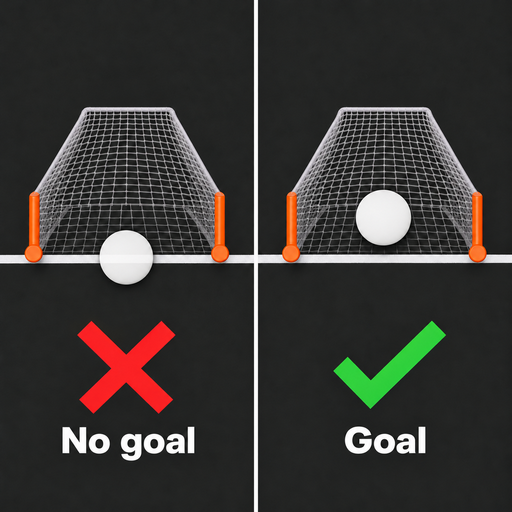
Yes. The whole ball must completely cross the goal-line plane, between the posts and below the crossbar.
A ball resting partly across the line is not enough. Neither is a shot striking the outside of the net.
A ball that legally crosses completely and then rebounds out can still be a goal. Staying in the net is not the deciding test.
Why was a Lacrosse goal disallowed?
Possible reasons include:
- An attacking player committed a crease or goal-circle violation
- The shooter illegally interfered with the goalkeeper
- The attacking team committed a Lacrosse foul that invalidated the scoring play
- Play had already stopped
- The shot failed the applicable timing requirements
- An equipment violation required the goal to be canceled
Crease entry and airborne finishes are especially dependent on the rule set. A highlight from professional men’s Lacrosse should not be treated as proof that the same move is legal in a youth or women’s game.
Lacrosse referee goal signals
Officials commonly signal a goal by raising both arms overhead. A waved-off goal is indicated differently, often with a sweeping arm motion.
Watch the official before celebrating a close call. The scoreboard operator may need a moment to update the display, and a review or equipment check can affect the final decision.
How to Read a Lacrosse Scoreboard
Start with three pieces of information: team names, team scores, and time remaining.
Everything else adds context.
How to tell which team is winning in Lacrosse
The team with the higher displayed score is leading.
Imagine a hypothetical Chicago-area game showing:
HOME 9 | GUEST 7 | Q4 | 3:42
That means:
- The home team leads by two
- The game is in the fourth quarter
- There are three minutes and 42 seconds left in that quarter
“Q4” does not mean four goals. “3:42” does not represent elapsed game time on a countdown display.
Broadcast graphics may also show rankings, records, or seed numbers beside team names. Those smaller numbers are not necessarily part of the score.
What does the shot clock mean in Lacrosse?
The shot clock limits how long an offense can hold possession without satisfying the competition’s shooting requirements.
It differs from the game clock:
- Game clock: Time remaining in the quarter or period
- Shot clock: Time remaining in the current possession allowance
- Penalty clock: Time remaining on a timed penalty
Shot-clock lengths and reset rules vary. Simply throwing the ball toward the goal does not necessarily satisfy the rule or earn a reset. Under some youth Lacrosse rules, games are played without a visible shot clock.
Read penalties alongside the score
A displayed penalty countdown can explain why one team has fewer players available.
That numerical advantage may create better scoring chances. It does not automatically make the next goal worth more points.
Lacrosse Overtime Scoring and Keeping Score
Once you understand the scoreboard, the next step is tracking how the game reaches its final result.
How does Lacrosse overtime scoring work?
NCAA men’s and women’s Lacrosse use sudden-victory overtime: the first legal overtime goal wins.
The goal does not receive extra value because it ends the game. Its importance comes from the result.
Overtime period lengths and procedures differ between competitions. Youth tournaments may also use special arrangements, so check the event rules before assuming every tied game follows the college format.
How to keep score at a Lacrosse game
For a personal score sheet, record each confirmed goal in sequence:
- Note the scoring team
- Record the scorer’s jersey number
- Write down the quarter and time
- Add the goal’s scoreboard value
- Record an assist only when confirmed
- Update the running score.
A useful entry might read: “Q2, 6:18 — Home #12, assisted by #7 — Home leads 5–3.”
For a two-point competition, include a separate goal-value column.
If you’re volunteering at the official table, follow the league’s instructions and coordinate with officials. Your duties may extend beyond tracking goals to penalties, timeouts, and roster information.
FAQ: Lacrosse Scoring, Goal Credits and Buzzer Rules
Can I score an own goal in Lacrosse?
Yes. If a player accidentally sends the ball into their own team’s goal, the goal counts for the opposing team. However, the player who caused the own goal is not necessarily credited with an individual goal; statistical credit depends on the competition’s rules.
Does a Lacrosse goal count after the buzzer?
It can. NCAA rules allow a qualifying shot released before time expires to score afterward, subject to the conditions governing that shot. A release after expiration does not qualify. Check the specific competition’s rules, and distinguish the period-ending horn from the shot-clock horn.
What does a hat trick mean in Lacrosse?
A hat trick means one player scores three goals in a game. Three assists or three combined goals and assists do not make a hat trick.
Does an assisted Lacrosse goal add two points to the team’s score?
No. In a one-point format, it adds one team point. The scorer receives a goal, and the passer receives an assist, creating separate individual statistical credits.
Does a free-position or power-play Lacrosse goal count differently?
In standard field Lacrosse, it remains worth one team point. The scoring opportunity changes, but the goal’s value does not. A league’s separate two-point rule may apply when its requirements are met.
Takeaway: Follow Lacrosse Scoring With Confidence
Most Lacrosse goals are worth one team point, while individual player points usually combine goals and assists. Keep those totals separate, recognize the PLL’s two-point exception, and watch the officials confirm close scoring plays.
To follow the action and improve your Lacrosse game awareness, read the team scores first, then check the quarter, game clock, shot clock, and penalties. Remember that goal validity, buzzer situations, and overtime procedures depend on the competition.
With these basics, you can understand a box score, track a comeback, or keep a clear scoring record from the sidelines.
Know the score, follow the momentum, and get ready for the next big play!
Ready to unlock your full potential ?