Lacrosse at the 2028 Games will use Sixes: six players per team, four eight-minute quarters, and a 30-second shot clock.
Men’s and women’s tournaments will feature this compact format, built around quick passing, rapid transitions, and frequent scoring opportunities. Each team normally fields five runners and one goalkeeper, with runners contributing on both offense and defense.
For casual viewers, the essentials are straightforward: follow possession, watch the countdown, and expect play to restart quickly after goals.
Whether you’re watching from home or heading to the Games, this guide makes Lacrosse at Los Angeles 2028 easy to follow without burying you in technical language.
Rules reference: This guide follows World Lacrosse’s May 2026 edition of the 2026–2028 Sixes rulebook. Any subsequent amendments or event-specific regulations should be checked before the 2028 competition.
Lacrosse Rules for the 2028 Games: The Basic Format
Sixes combines the stick skills of traditional Lacrosse with the constant movement familiar to basketball fans. Players carry, pass, catch, and shoot using a netted stick. Their objective is to put the ball into the opposing goal while preventing chances at the other end.
The Los Angeles 2028 event will feature six teams in each men’s and women’s tournament.
Sixes Lacrosse players and positions
A standard lineup includes:
- One goalkeeper, who protects the net and initiates transitions
- Five runners, who attack and defend
Think of runners as versatile teammates rather than permanently assigned attackers or defenders. After losing possession, the player who just attempted a shot may immediately need to sprint back and cover an opponent.
For viewers accustomed to specialized football units, that shared responsibility is a major adjustment. Watch who reacts first when possession changes: those opening steps often explain why a scoring opportunity develops.
Sixes vs field Lacrosse rules
Fans familiar with college Lacrosse will recognize the skills, but the rhythm differs.
| Feature | Sixes | Traditional field Lacrosse |
|---|---|---|
| Players per team on the field | Six, including the goalkeeper | More players; numbers vary by discipline |
| Player roles | Runners contribute at both ends | Greater positional specialization |
| Playing area | Compact field | Larger field |
| After a goal | Goalkeeper restart | Usually a center faceoff or draw |
| Defensive sticks | No long defensive poles | Long poles appear in men’s field play |
| Overall rhythm | Frequent transitions | More room for extended possessions |
The practical difference is easy to spot: there are fewer players available to cover mistakes.
Sixes Lacrosse Field Dimensions and Scoring Rules
Understanding the playing area
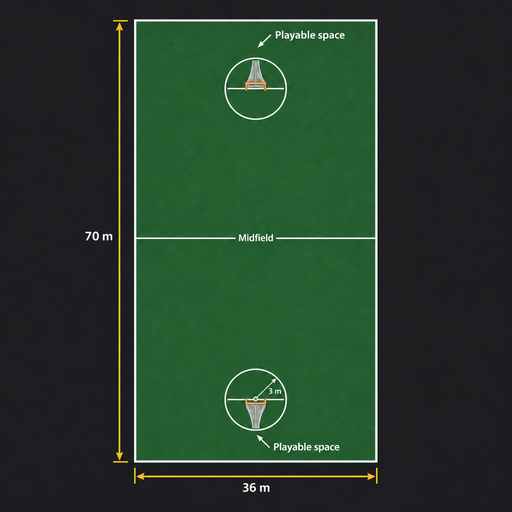
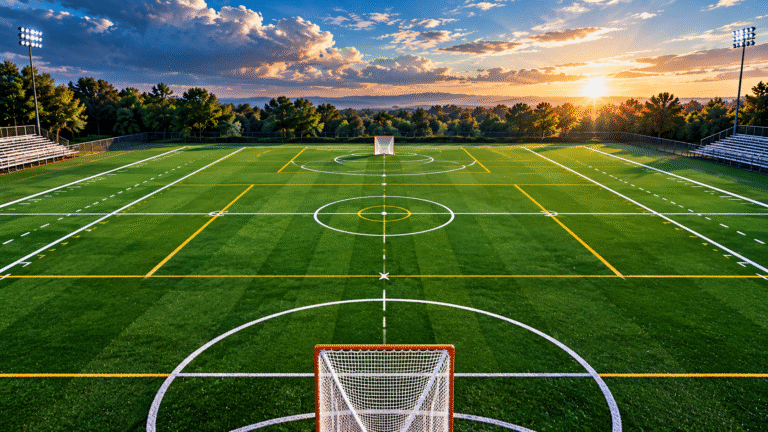
Official Sixes Lacrosse field dimensions are 70 meters by 36 meters, approximately 77 by 39 yards. Each goal measures 1.83 meters square—roughly six feet tall and wide.
A circular goal crease surrounds each net. Its three-meter radius creates a clearly marked area with special goalkeeper protections.
There is playable space behind the goals. That matters because an attacker behind the net can pass to a teammate cutting toward the front. Follow the receiving player rather than staring only at the ball.
Sixes Lacrosse scoring rules
Each legal goal adds one to the score. The ball must completely cross the goal-line plane between the posts and beneath the crossbar.
A spectacular finish can still be disallowed. For example, a release after the period expires does not count, and interfering with a protected goalkeeper can invalidate a goal.
For close plays, watch three things:
- Did the entire ball cross the line?
- Was the shot released before time expired?
- Did an attacking violation occur?
Can players enter the goal crease in Sixes Lacrosse?
Attackers cannot step into the opposing crease during live attacking play. Touching the crease line counts as being inside.
However, an attacker may reach a stick into the crease to play a loose ball without initiating contact with the goalkeeper. Defensive players have separate permissions and restrictions; the crease is not simply an area that everyone except the goalkeeper must always avoid.
When a close-range finish draws a whistle, watch the attacker’s feet for a possible crease violation.
Sixes Lacrosse Game Length and Shot Clock
How long does a game last?
The Sixes format used for Lacrosse’s 2028 comeback has 32 minutes of regulation playing time, divided into four eight-minute quarters.
The game generally uses a running clock, with specified stoppages. During the final two minutes of the fourth quarter, the clock stops for dead balls on the official’s whistle. Overtime also uses stopped time.
Breaks, timeouts, penalties, and other interruptions make the actual viewing time longer than 32 minutes.
How the Sixes Lacrosse shot clock works
The Sixes Lacrosse shot clock gives a team 30 seconds when it gains possession. Failing to produce a qualifying shot before expiration results in a turnover.
This makes the countdown valuable viewing information. With plenty of time remaining, an offense can move defenders through passing and cutting. As the clock approaches zero, expect a more urgent attempt.
A separate rule requires a team gaining possession in its defensive half to move the ball across midfield within 10 seconds. Those seconds are part of the possession, not an additional allowance.
When does the shot clock reset in Sixes Lacrosse?
Common reset situations include:
- A change of possession
- A qualifying shot striking the goal frame
- A qualifying shot rebounding off a goalkeeper positioned within the crease
- Certain defensive fouls and other specified stoppages
Not every touch earns another 30 seconds. A pass deflected by a defender does not automatically reset the clock, nor does contact with a goalkeeper outside the crease. A timeout also does not automatically provide a fresh possession clock.
For shot-related resets, the stick head must be above goal-line extended when the ball is released—on the field side of an imaginary line running through the goal.
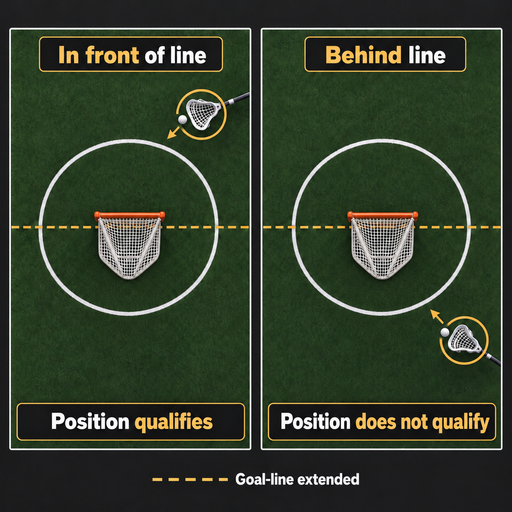
The useful viewing habit: check whether the countdown actually resets before assuming the offense has more time.
Possession, Restarts, and Substitutions in Sixes
What happens after a goal in Sixes Lacrosse?
The team that conceded restarts through its goalkeeper, rather than contesting another center faceoff.
The goalkeeper must retrieve and possess the ball within the official’s five-second count. Once ready, the official whistles play back in and resets the shot clock. A separate five-second crease-possession count then applies.
That restart creates an immediate tactical question: will the goalkeeper find an outlet before the scoring team organizes its defense?
Who gets possession when the ball goes out of bounds in Sixes?
Normally, possession goes to the opponent of the player who last touched the ball.
A clean missed shot that flies out therefore gives the defending team possession. Being the nearest attacker to the boundary does not preserve the ball.
However, an important exception applies when a shot hits the post, crossbar, or goalkeeper and goes directly out without intervening possession: the offense retains the ball and receives a shot-clock reset.
How do substitutions work in Sixes Lacrosse?
Players can substitute during play through the designated substitution area. The incoming player must wait until the teammate being replaced leaves the field.
This makes bench management part of the action. A tired runner needs relief, but a poorly timed change can create space for the opposition.
For USA supporters watching a fast break, look beyond the ball carrier: an opponent changing players may explain the sudden opening.
Sixes Lacrosse Fouls and Penalties: What the Whistle Means
The easiest way to understand Sixes Lacrosse fouls and penalties is to separate possession violations from more serious misconduct.
Minor fouls and major fouls
Minor fouls include procedural violations, illegal picks, and other restricted actions. Their consequences depend on possession and circumstances: they can produce a turnover or a 30-second penalty.
Major fouls generally bring a one-minute penalty. Examples include illegal body checking, slashing, and intentional tripping. Three major fouls cause a player to foul out; expulsion offenses also remove a player.
A time-serving penalty can leave one team shorthanded. Watch how the attacking team spreads the defense and moves the ball toward the uncovered player.
Are body checks allowed in Sixes Lacrosse?
Body checking is prohibited in both men’s and women’s Sixes.
Incidental contact and certain legal defensive actions remain possible, so every collision is not automatically a foul. The distinction is between permitted contact during play and an illegal body check.
Stick checks also have limits. Reckless swings and dangerous contact can draw penalties even when a defender is trying to win possession.
For a casual viewer, watch the defender’s action, not simply whether the attacker falls.
FAQ: Lacrosse Rules for the 2028 Games Explained
How do you watch Sixes Lacrosse and understand the rules?
Follow possession first, then glance at the shot clock and count the available defenders. Watch movement away from the ball: a runner cutting into open space often reveals the next scoring chance before the pass arrives.
When are faceoffs used in Sixes Lacrosse?
Center contests normally begin quarters and overtime periods, with specified exceptions, including some situations involving an existing player advantage. Men use a ground faceoff; women use a standing draw. Goals lead to goalkeeper restarts.
What happens if a Sixes Lacrosse game ends in a tie?
Under the May 2026 rules, teams play a full three-minute overtime period using stopped time. The team ahead at its conclusion wins. Additional periods follow if needed. This is not sudden-death overtime.
What are the differences between men’s and women’s Sixes Lacrosse rules?
The central format is shared, but equipment requirements, center-contest techniques, and certain checking and defensive-crease rules differ. Neither discipline permits body checking. Treat them as closely related competitions with specific variations.
Can the goalkeeper cross midfield in Sixes Lacrosse?
No. A goalkeeper touching or crossing the center line with the body commits an offside violation. The five runners handle movement into the attacking half while the goalkeeper supports play from the defensive end.
Takeaway: Watch Lacrosse 2028 With Confidence
Understanding Sixes starts with the objective of Lacrosse: outscore the opposition by making each possession count. Notice how quickly runners switch responsibilities, how the goalkeeper launches the next attack, and how defenders respond when a teammate needs help.
The compact field makes those decisions easier to see once you know where to look. You do not need to memorize every officiating detail to enjoy the competition.
Start by following one attacking possession, then watch how the same players defend the return trip. Whether you’re cheering for the USA or another team, you’re ready to follow the momentum.
Find your team, catch the next transition, and enjoy the game!
Ready to unlock your full potential ?