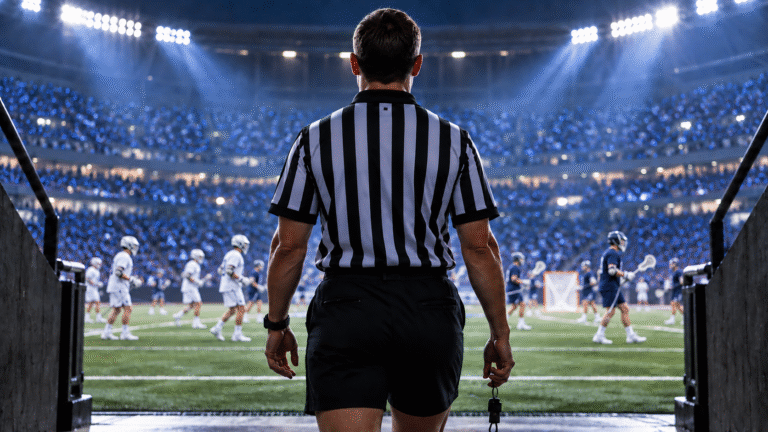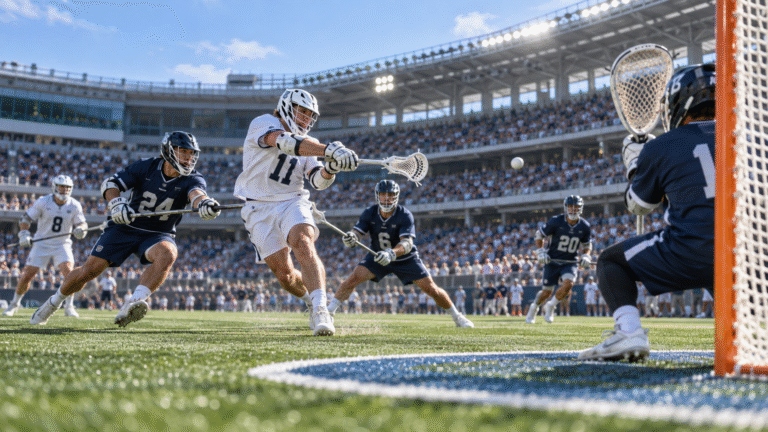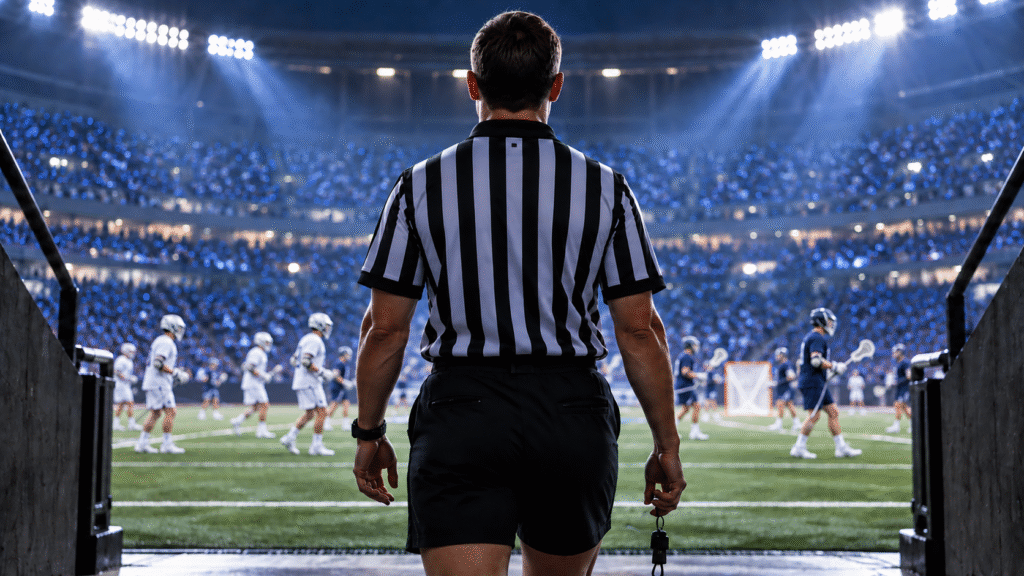
Three on-field officials control a Lacrosse Sixes game, supported by table personnel who manage scoring, penalties and the clocks.
At the 2028 Games, their calls will shape a fast game in which possession can change in seconds.
The essentials for viewers are straightforward: officials judge fouls, boundaries, goals and restarts, while the shot-clock operator runs the 30-second display. An on-field official makes the final shot-clock violation call.
This guide explains what to watch and why a whistle may lead to a penalty, a turnover or a quick restart. It follows World Lacrosse’s published 2026–2028 rules. The officials’ calls are one part of the story as Lacrosse returns at Los Angeles 2028.
Lacrosse Sixes Refereeing Rules: Who Makes the Calls?
A Sixes game has three on-field officials, including a Head Official. They work with an official scorer, timekeeper, penalty timekeeper and shot-clock operator.
The on-field officials:
- Judge fouls, possession and goals
- Signal shot-clock resets and violations
- Manage restarts and player safety
- Report time-serving penalties to the table
The table personnel operate the clocks and record what happens. For example, the shot-clock operator sounds the horn at zero, but an on-field official is responsible for signaling the violation.
What does each referee watch during a Sixes Lacrosse match?
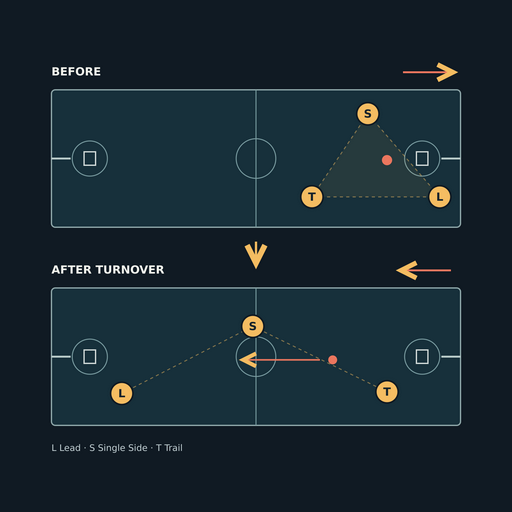
There is no permanent “foul referee” or “goal referee.” Coverage changes as the ball moves. World Lacrosse’s officiating manual calls the three on-field positions Lead, Trail and Single Side. In settled play, the crew forms a wide triangle around the action.
That gives officials different views of:
- The ball carrier and immediate defender
- Contact away from the ball
- Action near the goal and crease
- The next play as possession changes
After a turnover, officials move into new positions to follow the fast transition play that could shape the competition at Los Angeles 2028.
The new Lead runs ahead toward the goal, while the new Trail follows the attack and monitors the clear. Sixes Lacrosse referee positioning is always moving with the game.
Sixes Lacrosse Foul Calls and Penalty Enforcement
How do referees call fouls in Sixes Lacrosse? First, they identify the infraction. Then they apply the rule based on its severity and which team has the ball.
A minor foul can produce different outcomes:
- Offending team has possession, or the ball is loose: The other team is awarded possession
- Non-offending team has possession: The player who committed the foul serves 30 seconds
Under the Sixes rules for the 2028 format, a major foul generally brings a one-minute suspension and possession for the non-offending team. Illegal body checking is a major foul under the current Sixes rules. A player who receives three major fouls fouls out.
| Call | What usually happens |
|---|---|
| Minor foul when the offending team has the ball | Possession goes to the other team |
| Minor foul when the non-offending team has the ball | Offending player serves 30 seconds |
| Major foul | Player serves one minute; the other team generally gets possession |
| Shot-clock violation | Possession goes to the defense |
These are the common outcomes. The rulebook also covers situations such as coincidental fouls and delayed penalties.
What happens after a penalty in Sixes Lacrosse?
For a time-serving foul, the official reports the decision to the penalty timekeeper. The player goes to the penalty area and returns through the substitution area when released.
Penalty time begins when the player is seated or when play restarts, whichever happens later. Officials must make sure the right player, penalty length and restart are established before play continues.
So if a game pauses after a foul, watch the penalty area as well as the ball. That short delay helps the crew restart with the correct players and clocks.
Sixes Lacrosse Shot Clock Officiating and Game Clock Rules
A team has 30 seconds after gaining possession to produce a qualifying shot on goal. If the clock expires without one, the defense receives the ball. The on-field officials signal when the clock should reset.
When do officials reset the Sixes Lacrosse shot clock?
Common reset situations include:
- A change of possession
- A goal, followed by the official’s restart whistle
- A qualifying shot that hits the goal frame
- A qualifying shot that rebounds off a goalkeeper standing in the crease
- A restart after a time-serving foul is administered
A shot that simply misses the goal does not earn an automatic reset. Neither does a team timeout. If a shot hits a defender or a goalkeeper outside the crease, that contact alone does not reset the clock.
There is also a separate 10-second count when a team gains possession in its defensive half: it must move the ball across the center line within that time. After certain stoppages in the defensive half, the team receives a new 10-second count, while the shot clock continues from where it stopped.
How do Sixes Lacrosse game clock rules work?
Regulation has four eight-minute quarters. The game clock stops for:
- Timeouts
- Administration of time-serving penalties
- The end of a quarter
- A whistle for a dead ball in the final two minutes of the fourth quarter
- Whistles during overtime
The game clock and shot clock serve different purposes. A whistle may stop play without giving the attacking team another 30 seconds. When the ball goes out of bounds, for example, the shot clock stops; officials still have to apply the rule for possession and any reset.
Quick Restarts, Boundaries and Substitutions
Sixes rarely stays still for long. After an out-of-bounds call or foul, officials must establish possession, apply the restart rules and check what the clocks should show.
Who decides possession after the ball goes out in Sixes Lacrosse?
The on-field officials apply the boundary rules:
- If a player carrying the ball steps on or beyond a boundary, that player’s team loses possession
- If a loose ball goes out, possession normally goes to the opponent of the player who touched it last
- A missed shot that goes out does not automatically return to the shooting team
- If a shot hits the goal frame or goalkeeper and then goes out, the attacking team keeps possession and receives a shot-clock reset
That last distinction can change an entire possession. When a shot goes out, look for what it touched before crossing the line, then check the official’s signal.
How do referees manage quick restarts in Sixes Lacrosse?
The crew communicates the direction of play and gets the ball to the correct restart spot. Officials also monitor substitutions near the benches. A breach of the substitution rules can be called as a minor foul. A penalized player must wait for release by the penalty timekeeper and re-enter through the substitution area.
For a viewer, a quick checklist helps:
- Follow the possession signal
- Check the shot clock
- Look toward the penalty area if an official has called a time-serving foul
Those three cues explain most restarts before the next attack reaches the goal.
What to Watch at the Los Angeles 2028 Games
For fans watching from Los Angeles, New York or anywhere else in the USA, the pace of Sixes may be the biggest adjustment. Officials have to switch their coverage quickly as a save or turnover sends play toward the opposite goal. World Lacrosse’s manual emphasizes staying ahead of transitions and keeping the action within the crew’s view.
How is Sixes Lacrosse refereeing different from field Lacrosse?
Sixes has its own published rules and officiating mechanics. Particularly important calls involve:
- The 30-second shot clock
- The 10-second advance count
- Rapid changes of possession
- Out-of-bounds shots and their reset exceptions
- Three-official positioning around fast transitions
An official familiar with another form of Lacrosse should check the Sixes rulebook rather than assume every call or restart works the same way.
How can a referee prepare to officiate Sixes Lacrosse?
A practical preparation plan is to:
- Read World Lacrosse’s 2026–2028 Sixes rulebook
- Study its Sixes officiating manual
- Practice foul and shot-clock scenarios with a crew
- Work on transition positioning in live games
- Use introductory training, including USA Lacrosse’s Sixes course for officials
The published rules explain how Sixes is officiated. The names of the Lacrosse Sixes officials at the 2028 Games, along with any event-specific procedures, should be verified through official announcements closer to the event.
FAQ: Lacrosse Sixes Refereeing at the 2028 Games
How many referees officiate a Sixes Lacrosse game?
Three on-field officials control the game, including one Head Official. Table personnel handle supporting scoring, timing and penalty duties.
When do officials reset the Sixes Lacrosse shot clock?
They signal a reset for specified events, including a change of possession and certain shots that hit the goal frame or a goalkeeper in the crease. A timeout alone does not reset it.
Who decides possession after the ball goes out in Sixes Lacrosse?
The on-field officials decide by applying the out-of-bounds rules. Last touch usually determines possession on a loose ball, with a specific exception for certain shots.
How do Sixes Lacrosse officials handle substitutions?
They monitor whether players enter and leave through the required substitution area and can call an illegal substitution as a minor foul. The penalty timekeeper controls release from time-serving penalties.
Who will officiate Lacrosse Sixes at the 2028 Games?
The rulebook describes the officiating system, but it does not name the crew for the 2028 event. Check official announcements for assignments and event-specific details.
Takeaway: Understanding Lacrosse Sixes Refereeing in 2028
Three on-field officials make the calls that keep a Sixes game fair and moving: fouls, possession, goals and restarts. The table supports them by running the clocks and recording penalties.
The key for viewers is to remember that a whistle does not always mean a fresh shot clock, and a foul can lead to either a turnover or time in the penalty area.
At the 2028 Games, follow the official’s possession signal, glance at the clock and watch for a player heading to the penalty area. You’ll read the game faster with every play. Keep your eyes up—the next transition is already on.
Ready to unlock your full potential ?