Choosing your first Lacrosse stick comes down to four things: your position, the correct stick length, a beginner-friendly head, and a shaft you can comfortably control. For most new players, a complete stick designed for beginners is the easiest and smartest starting point because the head, pocket, and shaft are already matched.
You don’t need the most expensive setup in the store. A good Lacrosse stick for beginners should make catching, passing, cradling, and learning proper technique easier. This guide explains exactly how to choose a Lacrosse stick without getting lost in specifications you don’t yet need.
Your Position Determines the Right Lacrosse Stick
Before comparing brands, materials, or prices, determine where you’ll play. The right Lacrosse stick by position can vary significantly because attackers, midfielders, defenders, and goalies have different responsibilities.
Attack and midfield
Attackers and midfielders generally use shorter sticks because they need quick hands, close control, and fast passing.
For a beginner, this type of stick is usually the easiest to handle. A shorter setup helps new players develop fundamental skills without fighting unnecessary length or weight.
If you’re joining a youth program, playing high school Lacrosse, or simply learning in the backyard, prioritize control and comfort over advanced performance features.
Defense and long-stick midfield
Defensive players use longer shafts that provide greater reach for checking, disrupting passes, and defending opponents.
However, younger players may use sticks adjusted according to age, league rules, and their physical size. Buying the longest possible defensive stick simply because it is legal is rarely the best strategy for a beginner.
The player must still be able to control it effectively.
Goalie
Goalies use a dramatically wider head designed to stop shots rather than maximize ordinary ball control.
A goalie stick is therefore a specialized purchase. If you’re still unsure about your position, don’t buy one simply because the oversized head appears easier for catching.
Here’s a practical starting point:
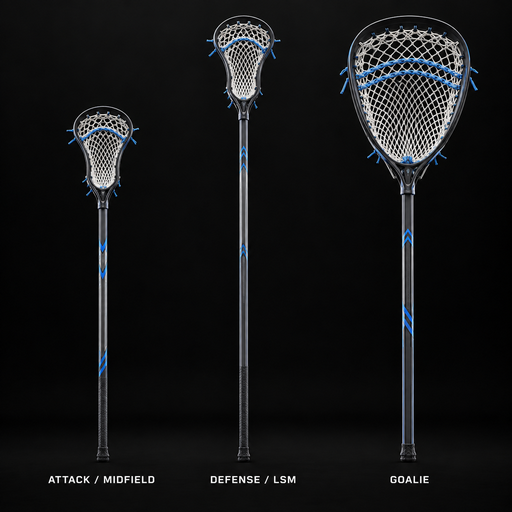
| Position | Typical Stick Characteristics | Beginner Priority |
|---|---|---|
| Attack | Shorter stick, narrower head | Control and quick handling |
| Midfield | Shorter, versatile setup | Balanced performance |
| Defense | Long shaft | Reach without excessive weight |
| LSM | Long shaft | Mobility and defensive control |
| Goalie | Very wide goalie head | Saving and clearing |
So, how to choose a Lacrosse stick by position? Start with what the player actually needs to do on the field, then select the simplest stick that supports those responsibilities.
Lacrosse Stick Size Guide: What Size Lacrosse Stick Do I Need?
Stick length is one of the most important—and most misunderstood—parts of choosing equipment.
When beginners ask, “what size Lacrosse stick do I need?”, there isn’t one universal measurement. Appropriate length depends on position, age, league requirements, and the player’s ability to handle the stick comfortably.
How long should a Lacrosse stick be for a beginner?
For field players, stick dimensions are regulated according to the game and position. Men’s field Lacrosse, women’s Lacrosse, youth competition, and goalie play don’t all use identical equipment standards.
That means parents should avoid buying purely from an age label such as “10+” without checking the requirements of their child’s league.
The practical rule is simple: use the correct legal range, but don’t automatically assume longer is better.
A beginner should be able to:
- cradle without the stick feeling unwieldy
- pass without excessive effort
- catch while keeping the head under control
- move naturally with the stick
- maintain proper hand positioning
For younger players especially, an oversized stick can make basic mechanics unnecessarily difficult.
Youth players need special attention
A 9-year-old learning in California may need a very different setup from a varsity defender in Pennsylvania. Youth organizations may also apply age-specific equipment rules, so parents should confirm requirements with the local club or league before cutting a shaft or buying a replacement.
This is where a dedicated Lacrosse stick size guide becomes more useful than simply copying what an older teammate uses.
The goal isn’t to give a young player the biggest legal stick. It’s to give them equipment that allows them to develop sound mechanics.
Lacrosse Stick Parts Explained: Head, Pocket and Shaft
Understanding the basic components makes shopping much easier. You don’t need to become a gear expert, but knowing the main Lacrosse stick parts explained in practical terms will help you recognize which features actually matter.
Lacrosse stick head types
The head is the plastic frame at the top of the stick. Its shape affects catching, ball retention, passing, shooting, and overall handling.
Different Lacrosse stick head types are designed around different priorities. Advanced offensive heads may emphasize ball control and shooting, while defensive heads can prioritize stiffness and durability.
For a beginner, versatility is usually more valuable than specialization.
A relatively forgiving head can provide a larger effective catching area and make early practice sessions less frustrating. Extremely specialized heads generally provide little advantage to someone still learning basic passing and catching.
The pocket matters more than beginners realize
The pocket is the mesh or stringing inside the head that holds and releases the ball.
Pocket depth, placement, tension, and shooting strings can influence how the ball sits and exits the stick. Poor stringing can make even an expensive head frustrating to use.
For beginners, consistency matters most. You want a pocket that makes catching manageable while providing a predictable release.
Don’t immediately chase the deepest possible pocket or maximum “hold.” Equipment still needs to comply with applicable rules, and excessive customization can hide weaknesses in technique rather than solve them.
Lacrosse shaft types
The shaft—or handle—is another major variable. Common Lacrosse shaft types use materials such as aluminum-based alloys, composite materials, and other lightweight metals.
Premium shafts may offer excellent strength-to-weight ratios, grip characteristics, or specific flex profiles. Beginners generally don’t need to pay heavily for these marginal performance differences.
Instead, ask: does Lacrosse stick weight matter for beginners?
It does, but lighter isn’t automatically better. The ideal beginner shaft should feel manageable without being so expensive or specialized that every ounce becomes a purchasing decision.
A new player needs enough comfort to practice repeatedly. That’s far more important than owning the lightest shaft on the sideline.
Complete vs Custom Lacrosse Stick: What Should a Beginner Buy?
One of the biggest purchasing decisions is complete vs custom Lacrosse stick.
A complete stick comes ready to play, with the head, pocket, and shaft assembled. A custom setup allows you to choose those components separately.
For most first-time players, a complete stick is the better option.
Should a beginner buy a complete Lacrosse stick?
Usually, yes.
Complete beginner sticks offer several advantages:
- components are designed to work together
- there’s less risk of choosing incompatible equipment
- the stick is typically ready to use
- pricing is easier to understand
- the player can focus on learning rather than equipment optimization
This is especially useful for parents buying equipment for a child entering a recreational program for the first time.
A custom stick becomes more attractive once a player understands their preferences. After a season or two, they may know that they want a particular head shape, pocket placement, shaft material, grip, or weight.
At that point, customization solves an actual need rather than an imaginary one.
How much should a beginner Lacrosse stick cost?
You don’t need a professional-level setup to learn effectively.
Entry-level complete sticks can often provide everything a new player needs, while higher-priced equipment increasingly incorporates performance-oriented materials and features.
Rather than choosing purely by price, ask what you’re paying for.
An inexpensive stick that is properly sized, well strung, and appropriate for the player’s position may be a much better first purchase than an expensive custom combination designed for an experienced athlete.
If you’re shopping at a specialty Lacrosse retailer, a sporting-goods store, or online anywhere in the USA, compare the function of the equipment, not just the price tag.
What Makes a Good Beginner Lacrosse Stick? Your Buying Checklist
So, what should I look for when buying a Lacrosse stick?
Strip away the marketing language and focus on usability.
What is the best Lacrosse stick for a beginner?
There isn’t one universally best model. The best beginner stick is the one that fits the player’s position and body, complies with the relevant rules, and makes fundamental skills easier to learn.
Before buying, check these factors:
- Position: Is it designed for attack, midfield, defense, or goalie?
- Length: Can the player comfortably control it?
- Head: Is it forgiving enough for someone developing catching skills?
- Pocket: Does it provide a consistent, predictable release?
- Weight: Can the player practice comfortably without sacrificing reasonable durability?
- Grip: Does the shaft feel secure in the hands?
- Rules: Is the setup legal for the player’s league and age group?
- Price: Are you paying for features the player can actually benefit from?
- Growth: For youth players, will the setup remain practical as skills develop?
This is ultimately what makes a good beginner Lacrosse stick: it removes unnecessary obstacles between the player and the fundamentals.
Don’t buy for the player you hope to become
One of the easiest beginner mistakes is purchasing equipment for an imagined future skill level.
A player sees what an elite college midfielder or professional athlete uses and assumes similar equipment will accelerate progress. Often, it won’t.
Someone starting Lacrosse doesn’t need an elite setup to develop a clean pass. A young player doesn’t need the lightest premium shaft to learn cradling.
Technique creates the foundation. Equipment should support it.
Once your skills and playing style develop, you’ll have much better information for choosing your next stick.
FAQ: Choosing a Lacrosse Stick for Beginners
What Lacrosse stick should a beginner use?
Most beginners should use a complete stick designed for their position and level. Look for manageable weight, appropriate length, a forgiving head, and consistent pocket. Avoid highly specialized equipment until you’ve developed clear preferences through regular play.
What size Lacrosse stick do I need?
Your ideal size depends primarily on your position, age, type of Lacrosse, and league rules. Attackers and midfielders typically use shorter setups than defenders, while goalies use specialized sticks. Youth players should check their league’s current equipment requirements before purchasing or modifying a stick.
How long should a Lacrosse stick be for a beginner?
A beginner should use a legal stick that they can comfortably control. Maximum allowable length isn’t necessarily optimal, particularly for younger players. Proper handling, passing mechanics, and confidence should guide the decision within the applicable rules.
Does Lacrosse stick weight matter for beginners?
Yes, but weight shouldn’t become the main purchasing criterion. A lighter stick may feel easier to maneuver, while durability and balance also matter. Beginners benefit most from a comfortable, reasonably lightweight stick that encourages frequent practice and good technique.
What is the best Lacrosse stick for a beginner?
The best Lacrosse stick for a beginner isn’t necessarily the most expensive model. Look for a complete, position-appropriate stick with a forgiving head, reliable pocket, manageable shaft, correct dimensions, and sensible price. As your game develops, you can upgrade individual components based on genuine playing preferences.
Takeaway: How to Choose the Right Lacrosse Stick With Confidence
Learning how to choose a Lacrosse stick is much easier when you ignore unnecessary technical hype.
Start with your position, choose the appropriate length, look for a forgiving head and consistent pocket, and select a shaft that feels comfortable to control. For most newcomers, a quality complete stick is the smartest first purchase because it provides a balanced setup without requiring detailed equipment knowledge.
Your first stick doesn’t have to be your forever stick. It needs to help you catch, pass, cradle, shoot, and enjoy learning the game. Choose smart, hit the field, put in the reps—and build your game from there.
Ready to unlock your full potential ?