Lacrosse conditioning without running can improve your endurance, muscular stamina, and movement control through timed bodyweight circuits, low-impact cardio, and short footwork drills. You need only a clear floor, a timer, and enough room to step safely in each direction.
The key is alternating purposeful work with recovery while maintaining good technique. Whether winter weather keeps you indoors or you have limited space in your apartment, consistent, structured sessions beat random exhausting workouts.
This guide focuses on the conditioning side of Lacrosse skills training, with practical exercises, a 20-minute routine, progression options, and an honest explanation of what home workouts can and cannot replace.
How to Build Lacrosse Stamina Without Running
Lacrosse requires repeated efforts: moving into space, defending, contesting possession, and recovering before the next play. At-home Lacrosse conditioning can develop general fitness that supports those demands.
However, different exercises provide different benefits:
- Continuous movement challenges your aerobic endurance
- Work-and-recovery intervals help you practice repeating demanding efforts
- Strength-endurance exercises develop your ability to sustain muscular work
- Controlled footwork reinforces balance and positioning
A burning squat hold does not automatically equal effective cardiovascular training. If your legs fail before your breathing increases substantially, switch to a movement you can sustain, such as marching with strong arm action.
Use effort to guide your workout
The CDC describes moderate effort as approximately 5–6 out of 10 and vigorous effort as 7–8. During moderate activity, you can talk but cannot comfortably sing; vigorous activity limits you to a few words between breaths.
Begin around moderate effort. Experienced players can use controlled vigorous intervals without making every round an all-out test.
Home workouts complement the field sessions in your weekly Lacrosse workout plan. They cannot fully reproduce sprinting, high-speed deceleration, reactive dodging, or the running demands of competition.
Low-Impact Cardio for Lacrosse in Limited Space
Low-impact cardio for Lacrosse keeps at least one foot grounded during standing movements. It offers useful options when jumping is noisy, uncomfortable, or impractical.
Set up a safe area for solo Lacrosse training: clear away furniture, check overhead space, and use a stable, nonslip surface. If you are avoiding running because of an injury, follow your clinician’s restrictions; low impact does not necessarily mean suitable for that injury.
Lacrosse conditioning exercises without equipment
Use these movements as a menu. Choose versions you can perform smoothly throughout the work interval.
| Exercise | How to perform it | Suggested starting interval |
|---|---|---|
| Power march | Drive your arms while lifting alternating knees; keep one foot grounded | 30–45 seconds |
| Step jacks | Step one foot sideways while raising your arms; alternate sides | 30–45 seconds |
| Standing shadowboxing | Throw controlled punches with soft knees; avoid snapping elbows | 30–45 seconds |
| Lateral step-and-reach | Step sideways, sit slightly through your hips, and reach comfortably | 20–30 seconds |
| Alternating knee drives | Bring one knee forward, lower it, then switch without hopping | 20–30 seconds |
For a Lacrosse cardio workout without jumping, alternate power marching, step jacks, and shadowboxing. Keep transitions simple so you spend more time moving.
Increase your arm action or movement pace gradually. Do not force bigger steps if your room cannot accommodate them.
Optional resistance band exercises for Lacrosse conditioning
A loop band can add resistance to lateral steps. A longer band can provide rows when secured to an appropriate anchor according to its instructions.
Use light resistance and controlled repetitions. Bands primarily add muscular work; they do not guarantee a stronger cardiovascular stimulus.
Bodyweight Workouts for Lacrosse Players: Strength and Footwork
Bodyweight workouts for Lacrosse players should develop useful movement quality alongside fitness. Avoid rushing every exercise simply to raise your heart rate.
Build strength endurance with three movements
Start with one or two rounds:
- Squats: 8–12 repetitions. Sit between your hips, keep your heels grounded, and stand smoothly
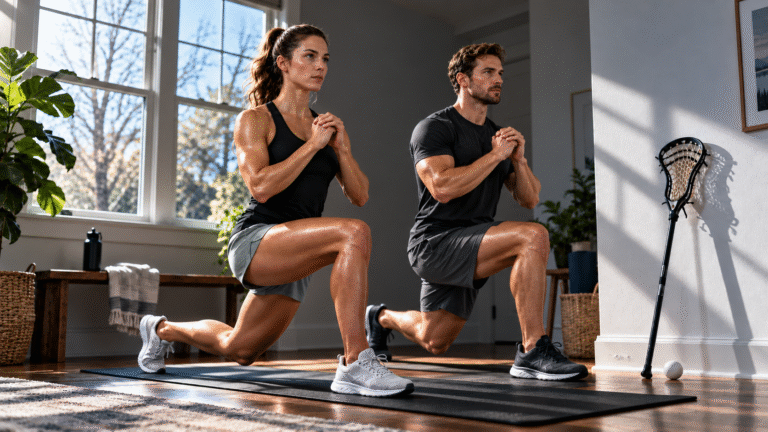
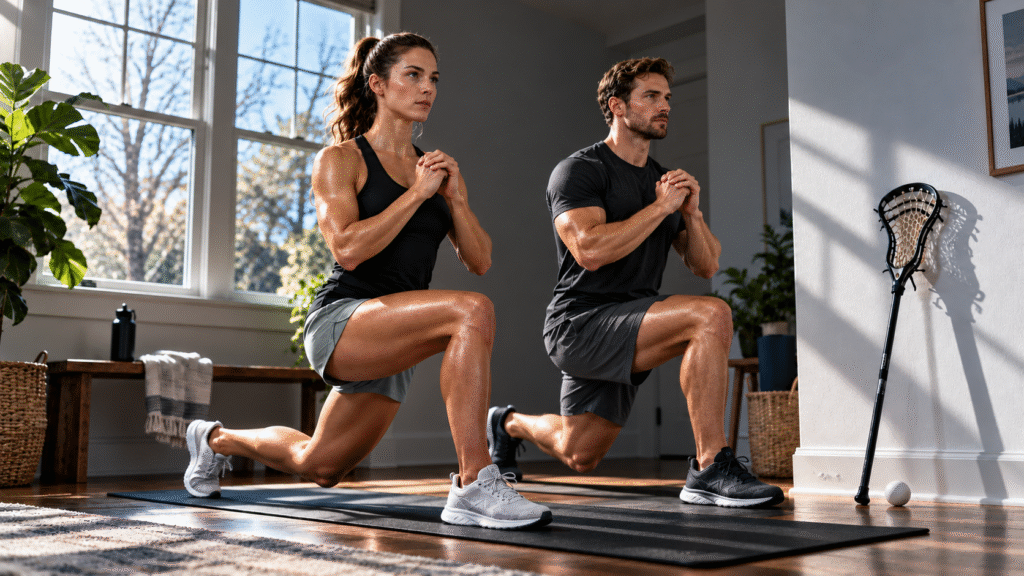
- Reverse lunges: 6–8 per side. Step backward within your available space. Use a stationary split squat if stepping feels unstable
- Wall or floor push-ups: 6–12 repetitions. Choose the version that allows a straight body position and controlled lowering
Stop each set while you could still complete a few good repetitions. Continuous technique breakdown is a signal to reduce difficulty.
Small-space Lacrosse agility drills
For Lacrosse footwork drills in a small space, place two flat tape markers approximately 2–3 feet apart.
Step between them in a defensive stance:
- Lead with the foot closest to your direction of travel
- Follow with the other foot without crossing your legs
- Keep your chest controlled and knees comfortably bent
- Pause briefly before reversing direction
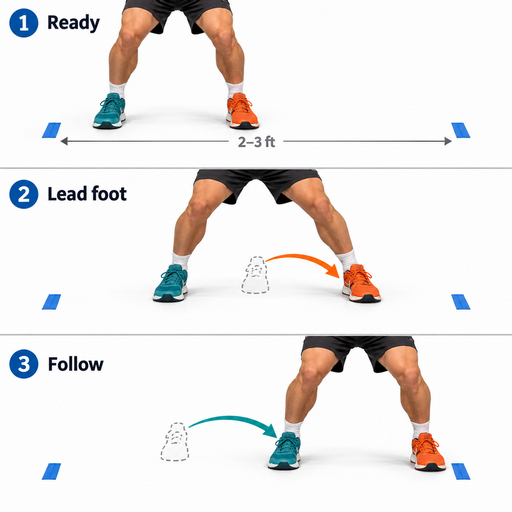
Practice for 10–15 seconds, then rest for 30–45 seconds. Complete four rounds.
A partner’s verbal “left” or “right” cue adds a decision-making element. Predetermined steps develop footwork; reacting to an unpredictable cue adds a basic agility challenge. Neither replaces field-speed practice.
Core endurance exercises for Lacrosse
Try dead bugs for 5–8 slow repetitions per side, followed by a side plank for 10–20 seconds per side.
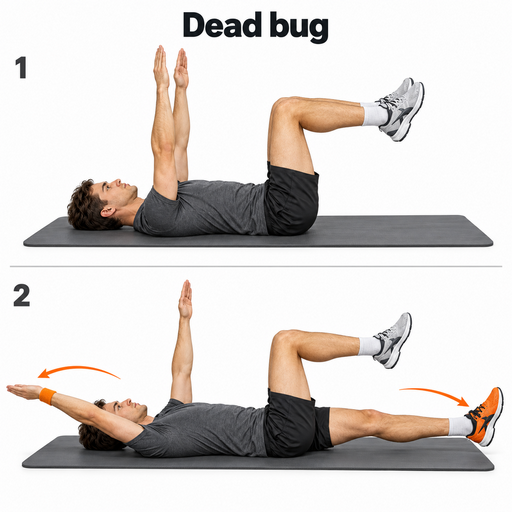
Keep breathing throughout. Shorten the hold or use a bent-knee side plank when your hips begin to drop.
A 20-Minute Lacrosse Conditioning Workout at Home
This sample Lacrosse conditioning workout plan combines cardio, muscular endurance, and recovery. It is a practical starting point, not a fitness test or a program tailored to the demands of individual Lacrosse positions.
Minutes 0–4: Warm up
Spend one minute on each:
- Easy marching with relaxed arm swings
- Comfortable side steps and shoulder circles
- Shallow squats alternating with calf raises
- Gradually faster marching and gentle knee drives
You should finish feeling warmer and ready to move, without being fatigued.
Minutes 4–16: Complete the circuit
Perform each exercise for 30 seconds, followed by 30 seconds of easy recovery. Repeat the six-station sequence twice:
- Power march with active arms
- Controlled bodyweight squats
- Standing shadowboxing
- Lateral step-and-reach
- Wall or floor push-ups
- Step jacks
Use recovery periods to breathe, reset, and transition safely. March gently or stand as needed.
For this version of Lacrosse interval training at home, aim for repeatable effort. Your second round should look similar to your first.
If push-ups become difficult before 30 seconds, stop the repetitions early and recover. Do not sacrifice form to fill the timer.
Minutes 16–20: Cool down
Slowly march for two minutes, then spend two minutes on relaxed breathing and comfortable calf, hip, and chest mobility.
For a beginner Lacrosse conditioning routine at home, use 20 seconds of work and 40 seconds of recovery at every station. The session still takes 20 minutes.
Progress Your At-Home Lacrosse Conditioning
Progress comes from a manageable challenge repeated consistently. Turning every session into a maximum-effort circuit makes it harder to judge improvement.
How to make home Lacrosse workouts harder
After several comfortable sessions, change one variable at a time:
- Increase work intervals from 30 to 35 seconds
- Reduce recovery from 30 to 25 seconds
- Add a separate round when you have more time
- Introduce light band resistance to an appropriate exercise
Keep the original exercise quality. Faster, shallower squats are not necessarily progress.
Record your intervals, exercise variations, and overall effort. Completing the same routine with steadier technique or lower perceived effort is useful evidence of improvement.
Advanced players may eventually need a bike, rowing machine, or field session to obtain a sufficient cardiovascular challenge.
Build a realistic weekly schedule
As a starting template, use two home conditioning sessions on nonconsecutive days, adjusted around practices and games. A player with several demanding team sessions may need less additional conditioning.
During winter, these workouts can help maintain a routine indoors. When field access returns, gradually rebuild running exposure rather than assuming indoor fitness guarantees sprint readiness.
FAQ: Lacrosse Conditioning Without Running at Home
How often should Lacrosse players do conditioning?
Start with two dedicated home sessions per week if your existing workload allows. Count practices, games, and lifting when planning recovery. Youth players should coordinate additional training with a coach and parent.
Can Lacrosse conditioning without running replace running completely?
It can build general endurance, but it does not fully prepare you for sprinting and repeated field movements. Players returning to competition should gradually restore those demands when appropriate.
How do I combine wall ball and Lacrosse conditioning at home?
Alternate two minutes of focused wall ball with one minute of marching or step jacks for four rounds. Use a permitted wall and safe throwing area. Pause if fatigue reduces throwing control.
What if my room is too small for Lacrosse lateral drills?
Use marching, step jacks with shorter steps, shadowboxing, and floor exercises. Skip movements that bring you close to furniture. You do not need lateral travel to complete a useful conditioning session.
How can I tell whether my Lacrosse stamina is improving?
Repeat the same workout under similar conditions. Look for fewer unplanned breaks, more consistent movement, and lower perceived effort. Track trends across several sessions instead of judging one unusually good day.
Takeaway: Build Lacrosse Fitness Without Running
Lacrosse conditioning without running gives you a practical way to train when space, weather, or access limits your options. Combine low-impact cardio with controlled strength exercises, short footwork practice, and core endurance work.
Start with the 20-minute routine, choose intervals you can repeat cleanly, and progress one variable at a time. Account for practices and games so extra workouts support your performance.
Remember that home conditioning develops a foundation; field-speed running and reactive movement still need their own preparation.
Consistency and quality are your priorities. Clear some space, set your timer, and put in work your next shift can build on.
Ready to unlock your full potential ?