
Women’s Lacrosse for beginners becomes much easier with a simple 30-day progression: choose the right equipment, understand the essential rules, learn the core stick skills, and practice consistently.
You do not need elite fitness or years of athletic experience. Most beginners can build confidence through short, focused sessions combining cradling, catching, passing, wall ball, footwork, and conditioning.
Whether you are joining a youth program, a high school team, or an adult club, this guide gives you a practical path from picking up a stick to feeling ready for your first practice.
How to Start Women’s Lacrosse With No Experience
The best answer to how to start playing women’s Lacrosse with no experience is to begin with basic movement and stick control—not complicated plays. During your first week, focus on becoming comfortable holding the stick, moving with it, and controlling the ball.
Women’s Lacrosse is fast and technical, but every experienced player once struggled to catch a clean pass. Progress comes from repetition, especially when practice sessions have one clear objective.
Set a realistic 30-day goal
Your goal is not to master the entire sport in one month. By Day 30, aim to:
- Hold and move the stick comfortably
- Cradle while walking and jogging
- Pass accurately over a short distance
- Catch routine passes consistently
- Scoop ground balls without stopping
- Use both hands during basic drills
- Understand common fouls and field positions
- Arrive prepared for your first team practice
These outcomes create the foundation for future development. A player who controls the ball confidently is better prepared to learn dodging, shooting, defensive positioning, and team tactics.
How often should a beginner practice women’s Lacrosse?
A beginner should practice four or five times per week for 20 to 40 minutes. Frequent short sessions usually build coordination more effectively than one exhausting weekly workout.
Alternate technical and physical work. For example, complete wall ball on Monday, footwork on Tuesday, stick skills on Wednesday, and conditioning on Friday. Allow at least one recovery day each week, particularly if you are new to running or field sports.
In established Lacrosse areas such as Maryland, Virginia, and Long Island, beginners may find numerous local programs. Players in developing markets like Texas, Colorado, or Southern California can look for recreation departments, school teams, USA Lacrosse–affiliated organizations, and adult clubs.
Women’s Lacrosse Equipment Guide for New Players
A beginner does not need the most expensive gear. Equipment should fit correctly, comply with the rules of the player’s league, and allow safe, comfortable movement.
What equipment do beginner women’s Lacrosse players need?
| Equipment | Why You Need It | Beginner Buying Tip |
|---|---|---|
| Lacrosse stick | Passing, catching, cradling, and shooting | Choose a legal complete stick with a beginner-friendly head |
| Protective eyewear | Protects the eyes during practices and games | Confirm that it meets the standard required by your league |
| Mouthguard | Protects the teeth and mouth | Select a comfortable model that allows clear communication |
| Cleats or turf shoes | Provide traction when accelerating and changing direction | Match the footwear to grass or artificial turf |
| Athletic clothing | Supports unrestricted movement | Wear moisture-wicking layers appropriate for the weather |
| Lacrosse balls | Needed for individual drills | Begin with several regulation balls and label them |
| Water bottle | Supports hydration during training | Bring it to every session, even in cool weather |
Goalkeepers require specialized protection, including a helmet, throat protection, chest protection, gloves, and other league-mandated equipment. Field players should check their local rules before purchasing gear because requirements can differ by age group and competition.
Choose the right beginner stick
A good beginner stick should feel balanced and manageable. A very advanced head or specialized pocket will not compensate for weak fundamentals. Ask a coach or experienced retailer to confirm that the stick is appropriate for your age, position, and governing rules.
Before every session, inspect the head, shaft, pocket, and strings. A damaged head or loose component can affect both safety and performance.
Prepare for different US playing conditions
Women’s Lacrosse is played in varied conditions across the USA. Players training in Florida may prioritize hydration and lightweight clothing, while athletes in Chicago or Boston may need warm layers during early-season practices. Pack a small gear bag with sunscreen, an extra mouthguard, hair ties, athletic tape, and weather-appropriate clothing.
Women’s Lacrosse Basic Skills Every Beginner Should Learn
The most important women’s Lacrosse basic skills are holding the stick, cradling, catching, passing, scooping, and changing hands. Learn them in that order so each new movement builds on the previous one.
How to hold a women’s Lacrosse stick correctly
Place your dominant hand higher on the shaft and your other hand near the bottom. Keep both hands relaxed rather than squeezing the shaft tightly. Your wrists need freedom to guide the stick head and absorb the ball.
The top hand controls most of the stick’s precision, while the bottom hand supports direction and leverage. Maintain an athletic stance with bent knees, balanced feet, and your head up.
How to cradle a Lacrosse ball for beginners
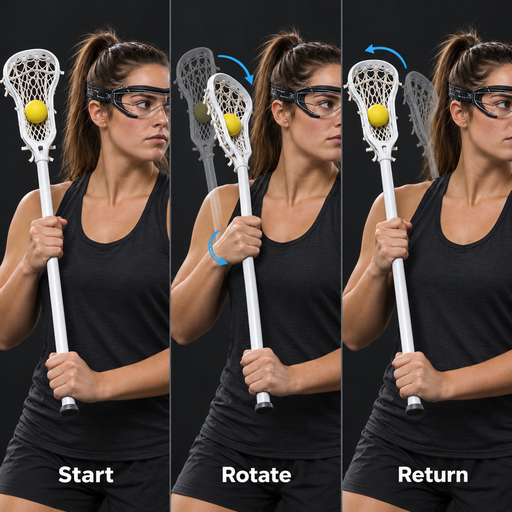
Cradling keeps the ball secure while you move. Start with the stick near shoulder height and use a controlled combination of wrist and arm movement. The motion should be compact—not a large swing across your body.
Practice in three stages:
- Cradle while standing still
- Cradle while walking with your eyes forward
- Cradle while jogging and changing direction
Avoid staring into the pocket. Players need their eyes up to recognize teammates, defenders, and open space.
How to catch a Lacrosse ball consistently as a beginner
Present the stick head as a visible target and watch the ball all the way into the pocket. As the ball arrives, move the stick slightly backward to cushion the impact. This “soft hands” technique prevents the ball from rebounding out.
For passing, turn your shoulders toward the target, lead with the hands, and finish by pointing the stick toward your teammate. Accuracy matters more than speed during the first month.
Scooping and switching hands
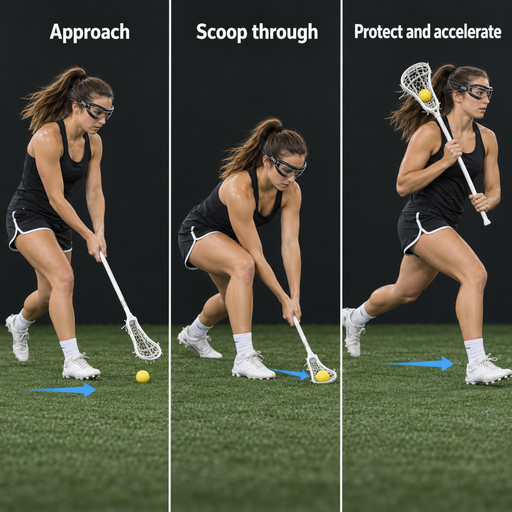
Approach a ground ball with bent knees, place your lead foot beside it, and lower both hands. Scoop through the ball without stopping, protect the stick near your body, and accelerate away.
Begin changing hands while stationary before attempting the movement at speed. Developing both sides early prevents dependence on the dominant hand and makes future dodging much easier.
Your 30-Day Lacrosse Training Plan
This 30-day Lacrosse training plan progresses from individual control to game-like movement. Most sessions require only a stick, several balls, a wall, cones, and a safe open area.
Days 1–7: Build comfort and control
During Week 1, learn your equipment and establish clean movement patterns.
- Practice correct hand placement
- Complete 50 stationary cradles on each side
- Walk while cradling with your head up
- Perform 25 ground-ball scoops from different angles
- Make short passes with a partner or rebounder
- Learn the basic field markings and positions
- Use Day 7 for recovery and light mobility
Prioritize technique over speed. Slow, correct repetitions create better habits than rushed drills.
Days 8–14: Beginner wall ball routine for women’s Lacrosse
Wall ball is one of the most efficient ways to improve passing and catching. Find a legal practice wall away from windows, vehicles, and pedestrians.
Complete this routine:
- 30 dominant-hand throw-and-catches
- 20 non-dominant-hand throw-and-catches
- 20 catch-right, switch, throw-left repetitions
- 20 catch-left, switch, throw-right repetitions
- 15 quick-stick repetitions without cradling
- 10 moving passes in each direction.
Stand close enough to maintain control. Step farther from the wall only after your passes become consistent.
Days 15–21: Add movement and conditioning
Now combine technical ability with acceleration, balance, and endurance. Use beginner women’s Lacrosse drills such as zigzag cradling, scoop-and-sprint repetitions, and pass-cut-catch patterns.
A practical women’s Lacrosse conditioning plan for beginners includes:
- Two interval-running sessions
- One bodyweight strength session
- Two stick-and-footwork sessions
- One mobility or active-recovery session
- One complete rest day
For intervals, alternate 30 seconds of running with 60 seconds of walking for 10 rounds. Increase intensity gradually rather than attempting an advanced college workout immediately.
Days 22–30: Prepare for realistic play
During the final phase, perform drills while scanning the field and making decisions. Add a passive defender, numbered targets, or directional commands when possible.
On Day 30, complete a simple skills check: cradle through cones, scoop five ground balls, make 20 passes with each hand, catch 10 consecutive controlled passes, and finish with short sprints. Record the results so you can measure future improvement.
Women’s Lacrosse Rules for Beginners and First-Practice Preparation
Women’s Lacrosse rules for beginners can seem complex, but new players initially need to understand only a few essential principles. Rules differ by age, school level, league, and governing body, so always follow your coach’s instructions and the current rulebook for your competition.
Learn the most important rules first
Beginners should understand that:
- Players use their sticks to carry, pass, catch, scoop, and shoot the ball
- Dangerous stick movement and unsafe contact can result in penalties
- Players must respect the protected space around an opponent’s head
- Field players cannot use their hands to catch or carry the ball
- Legal defensive positioning requires control, awareness, and safe technique
- The restraining line and shooting-space rules affect positioning and movement
- Play restarts according to the location and type of foul
Do not assume that women’s and men’s rules are interchangeable. Women’s Lacrosse has its own equipment standards, contact rules, field procedures, and tactical principles.
What to expect at your first women’s Lacrosse practice
Your first women’s Lacrosse practice will probably include a warm-up, stick-skills exercises, partner passing, ground balls, footwork, and a small-sided activity. The coach may also explain team terminology, positions, safety expectations, and practice routines.
Arrive 15 minutes early with your equipment ready. Introduce yourself to the coach and explain that you are new. Coaches would rather correct a beginner’s technique immediately than allow an unsafe habit to develop.
Do not measure your first session against players who have trained for years. Focus on listening, staying active, and attempting every drill. Effort, coachability, and consistency matter more than looking polished on Day 1.
FAQ: Starting Women’s Lacrosse for Beginners
Is women’s Lacrosse difficult to learn?
The basic concepts are accessible, but catching, cradling, and passing require repetition. Most beginners notice meaningful improvement within several weeks when they practice consistently.
How can I improve my weak hand in women’s Lacrosse?
Use your weak hand during short daily exercises. Begin with stationary cradling and close-range wall ball, then add passing on the move. Aim for correct technique before increasing speed or distance.
Can an adult start playing women’s Lacrosse?
Absolutely. Adult recreational and club programs welcome beginners in many US cities, including New York, Philadelphia, Denver, and Los Angeles. Ask prospective clubs whether they offer beginner instruction before registering.
What should I do before my first women’s Lacrosse practice?
Check your equipment, learn basic stick terminology, practice cradling and catching, hydrate, and arrive early. Contact the coach beforehand if you are unsure about protective equipment or footwear.
How long does it take to become comfortable with a Lacrosse stick?
Many beginners develop basic comfort within 30 days, but consistent control takes longer. Practicing for 20 to 30 minutes several times per week is more effective than relying only on team practices.
Takeaway: Start Your Women’s Lacrosse Journey in 30 Days
Starting women’s Lacrosse becomes manageable when you divide the game into clear, progressive steps. Get properly fitted equipment, learn the essential safety rules, and build your cradling, passing, catching, scooping, and weak-hand control through short, regular sessions.
A structured 30-day beginner plan gives you direction, measurable progress, and greater confidence before joining a team. You will not master every skill in one month, and you do not need to.
Show up prepared, accept mistakes as part of learning, and keep adding quality repetitions. Grab your stick, hit the wall, and start building your game—Day 1 begins now.
Ready to unlock your full potential ?