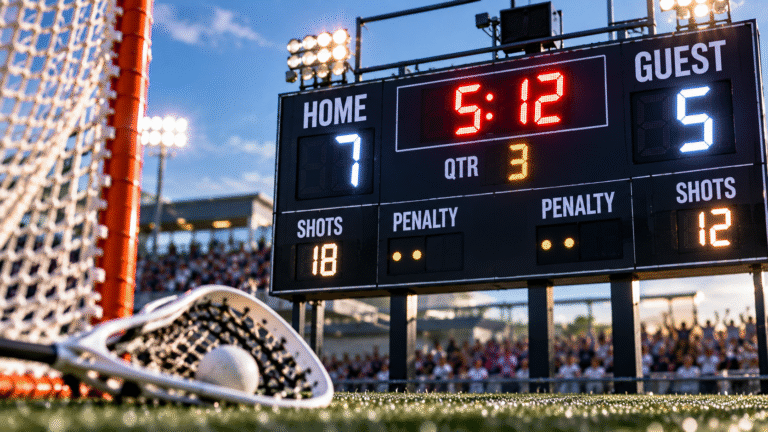
Ball possession in Lacrosse means a team has control of the ball. You’ll usually see a player secure it in their stick after a catch, a scoop, or a goalie save. When the ball is rolling free or bouncing between sticks, it’s a loose ball, and either team can win it while play is live.
If you lose sight of the ball, watch who can make the next pass, run, or shot. After a whistle, look for which team gets the restart.
Spotting changes in possession is one of the Lacrosse basics that helps you follow the game from the first whistle to the final buzzer.
How to Tell Who Has the Ball in a Lacrosse Game
Start with the stick pocket. A player with the ball can carry it, pass it, or shoot it. You may see them cradle, rocking the stick to keep the ball secure on the move. A player can also hold the ball with their stick still while looking for an open teammate.
Three clues you can spot from the stands
- Watch the catch. On a clean catch, the ball settles into the pocket and the player can turn to run or pass.
- Watch the defenders. Their heads and shoulders often turn toward the new ball carrier. On a wide broadcast shot, that movement can be easier to see than the ball itself.
- Watch what happens after a save. If the goalie secures the ball, look for teammates to spread out for an outlet pass. If the ball rebounds, watch who gets to it and controls it.
During a clean pass between teammates, the ball briefly leaves one player’s stick before reaching another’s. For a viewer following the flow of play, it’s still the same attacking sequence. A bobbled catch changes the picture. Both teams can now go after the loose ball.
How Lacrosse Ground Balls, Faceoffs, and Draws Start Possession
Lacrosse ground balls are up for grabs
A ground ball is a loose ball on the playing surface. It can come from a dropped pass, a stick check, or a rebound. The first player to reach it may knock it into open space, where someone else can scoop it and take control.
Where the pickup happens tells you what to watch next:
- Near the player’s own goal, they’ll usually look for an outlet away from pressure.
- Near midfield, a clean scoop can start a fast break while the other team is still turning around.
- Near the opponent’s goal, the player may have a chance to shoot before the defense resets.
Who gets the ball after a goal in Lacrosse?
That depends on the format you’re watching:
- NCAA men’s field Lacrosse. Play typically restarts with a faceoff, where two opponents contest the ball at ground level.
- NCAA women’s field Lacrosse. Play typically restarts with a draw, where two opponents use their sticks to send the ball into the air.
- World Lacrosse Sixes. The team that conceded typically restarts through its goalie. At the Los Angeles 2028 Games, that means the action can head the other way as soon as play resumes.
On a faceoff or draw, keep an eye on the players nearby. One player can direct the ball into space and a teammate can be the one who secures it.
How Lacrosse Turnovers, Clears, and Rides Change the Game
A turnover sends possession the other way. Sometimes there’s a whistle, such as when a ball carrier steps out of bounds. Other times the play keeps moving, as when a defender catches a pass and immediately takes off upfield.
Lacrosse clears and rides, explained
Watch the first few seconds after a goalie secures a save:
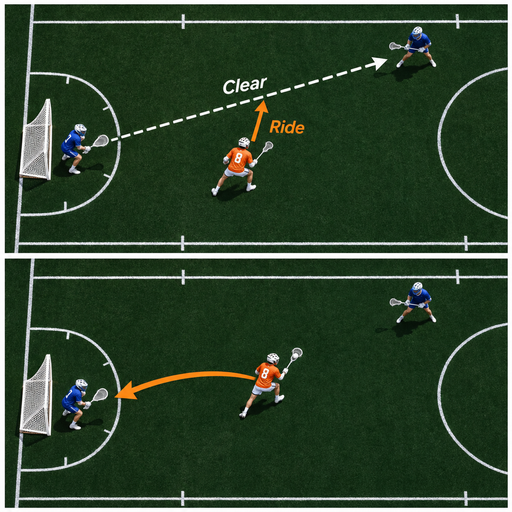
- The clear begins. The goalie or a teammate tries to move the ball from the defensive end into the attacking end.
- The ride puts pressure on the clear. The opposing team covers nearby passing options, pressures the ball carrier, or forces a difficult throw.
- One team wins the transition. A successful clear lets the new offense get set or attack quickly. If the ride forces a turnover, the team that just took the shot gets another chance.
What does a failed clear mean in Lacrosse?
A failed clear means a team loses the ball before it completes the move into its attacking end. Picture a goalie making a save and throwing an outlet pass toward the sideline. An opponent intercepts it and turns toward the same goal. The ball never made it upfield, and the goalie’s teammates may already be running in the opposite direction. That’s why a failed clear can lead to another shot within seconds.
Lacrosse Out-of-Bounds Rules and Possession After a Foul
Who gets the ball when a pass or shot goes out of bounds?
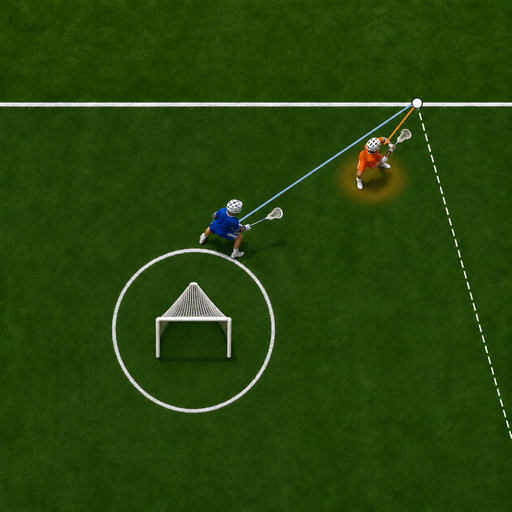
First, decide whether you saw a pass or a shot. In NCAA field Lacrosse, that distinction determines whether the official looks at who touched the ball last or who was closest when it went out.
Under the World Lacrosse Sixes rules, the last-touch rule generally applies to shots that go out of bounds, too.
| What you see | Who usually gets the ball |
|---|---|
| A pass goes out untouched | The team that defended the pass |
| A defender tips a pass out | The passing team, because the defender touched it last |
| A shot goes wide in NCAA field Lacrosse | The team with the eligible inbounds player closest to the ball when it goes out |
| A shot goes wide in World Lacrosse Sixes | The team opposite the last player to touch it |
In field Lacrosse, that explains why a player might sprint behind the goal even after a shot has clearly missed. They’re backing up the shot. If they’re closest when the ball goes out, their team can keep attacking. A defender can win that race, too.
Why does the same team keep the ball after a whistle?
A whistle stops play. When the defense fouls the team in possession, the attack can often keep the ball for the restart. An offensive foul can send possession the other way. If you missed the call, look for the player the official awards the ball to. That player’s team will start the next play.
Lacrosse Shot Clock Rules and What Happens When Time Runs Out
The game clock counts down the time left in the period. The shot clock limits how long a team has to take a qualifying shot. If time expires and the official calls a shot clock violation, the opponent gets possession.
The starting countdown varies by competition:
- NCAA men’s field Lacrosse: 80 seconds on a new possession, including clearing time when the team starts in its defensive half.
- NCAA women’s field Lacrosse: 90 seconds on a new possession.
- World Lacrosse Sixes: 30 seconds on a new possession.
If a shot hits the pipe or comes off a goalie save and the offense recovers, check the display. A qualifying shot can trigger a reset under that competition’s rules. With only a few seconds left, you’ll often see the ball carrier drive to goal or take a shot from farther out.
FAQ: Ball Possession in Lacrosse for First-Time Viewers
Does a tipped pass count as possession in Lacrosse?
A tip alone doesn’t establish possession. If a defender tips a pass and an attacker catches it, the attacker gains control and their team can continue the play.
Can either team pick up a loose ball in Lacrosse?
Yes. While the ball is live and inbounds, an eligible player from either team can scoop it and gain possession.
What happens when a Lacrosse pass is intercepted?
The team that catches the pass takes possession immediately. The player who made the interception can run or pass upfield while the other team switches to defense.
Does a blocked shot change possession in Lacrosse?
A block can leave the ball loose. The team that next secures the ball determines whether possession changes or the same team keeps attacking.
Do more possessions always mean more shots in Lacrosse?
A team can win possession and lose it before taking a shot. Another team can get several shots on one trip downfield by recovering rebounds or backing up missed shots in field Lacrosse.
Takeaway: Read a Lacrosse Game One Possession at a Time
At your next Lacrosse game, pick one team and follow a single possession. A ground-ball pickup can give them room to run. An intercepted pass can send them straight back on defense. Once they’re set up to attack, a dwindling shot clock can explain why they shoot from farther out.
After a whistle, find the player with the ball for the restart. If a shot went wide, the format you’re watching can explain why the same team gets another chance.
Test your game awareness after the next turnover. Watch the first few strides and see if you can call the fast break before the announcer does!
Ready to unlock your full potential ?