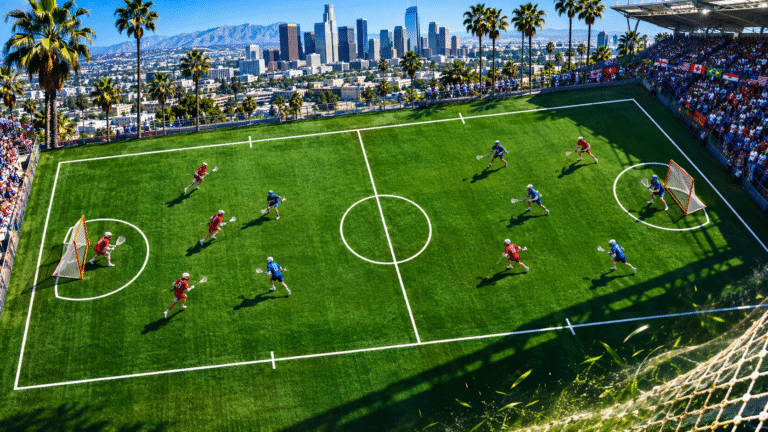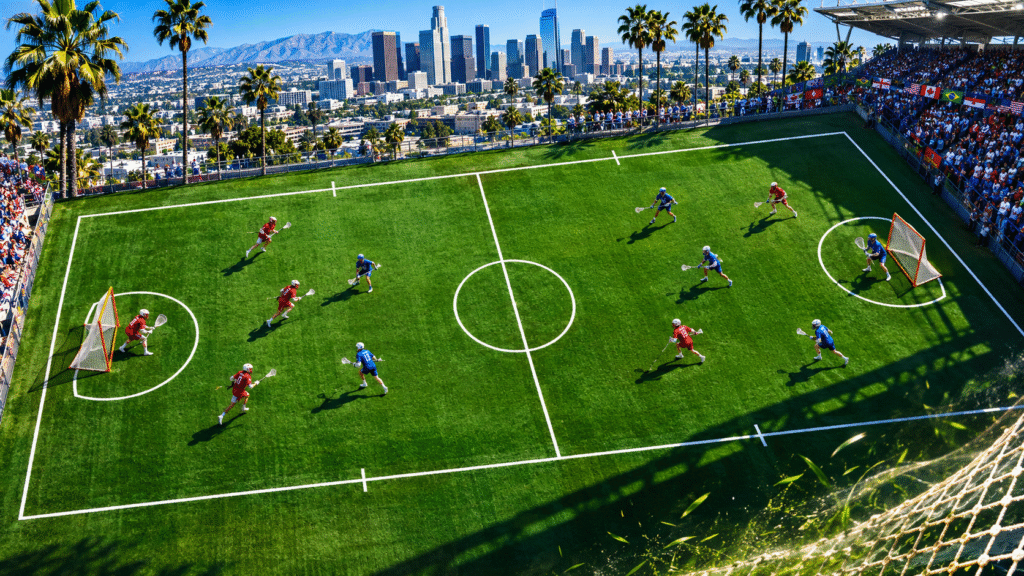
A regulation Lacrosse Sixes field is 70 meters long by 36 meters wide, or about 76.6 by 39.4 yards.
That’s the World Lacrosse standard for the Sixes format, which will be played at Exposition Park Stadium when Lacrosse returns at Los Angeles 2028.
On a wide shot, look for three features first: the draw circle at midfield, the crease around each goal, and the substitution area along the bench-side sideline. The goals sit inside the end lines, so players can work behind the net. Once you know those landmarks, it’s easier to follow the ball when play changes direction.
In this article, you’ll learn how the Lacrosse Sixes field is laid out, what its key markings mean, and how they shape the game.
Lacrosse Sixes Field Dimensions in Meters and Yards
The regulation dimensions run between the inside edges of the boundary lines. Use the yard and foot equivalents to picture the field and the metric measurements to mark it.
| Field feature | Regulation measurement | Approximate U.S. equivalent |
|---|---|---|
| Playing area | 70 × 36 m | 76.6 × 39.4 yd |
| End line to midfield | 35 m | 38.3 yd |
| Midfield to each goal line | 25 m | 27.3 yd |
| Center draw circle radius | 5 m | 16.4 ft |
| Goal crease radius | 3 m | 9.8 ft |
| Inside goal opening | 1.83 × 1.83 m | 6 × 6 ft |
| Substitution area | 10 × 5 m | 10.9 × 5.5 yd |
The table uses the World Lacrosse Sixes rulebook, with rounded U.S. conversions.
How much smaller is the field in Sixes compared with traditional field Lacrosse? Here’s how the playing areas stack up:
- Men’s field Lacrosse: USA Lacrosse shows a 110 × 60-yard field. Sixes uses about 46% of that area.
- Women’s field Lacrosse: USA Lacrosse lists 120 × 65 yards as the optimal size for a new field. Sixes uses about 39% of that area.
That smaller footprint is easy to appreciate after a save. A goalkeeper who spots an open teammate can start a break that reaches the other end in just a few passes.
Lacrosse Sixes Field Diagram and Boundary Lines
What will the Lacrosse Sixes field look like at the 2028 Games? Appendix A of the World Lacrosse rulebook shows the standard layout. When you open the Lacrosse Sixes field diagram, start with the outside rectangle and work toward the middle.
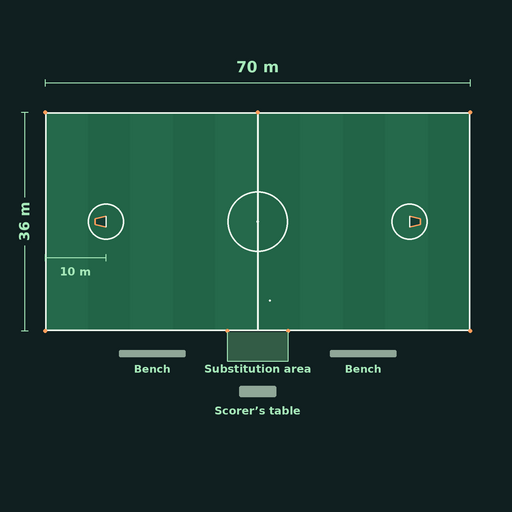
- Sidelines are the two long edges. The benches, substitution area, and scorer’s table sit along one of them.
- End lines are the two short edges. The space behind each goal is in bounds up to the end line, so attackers can carry or pass the ball behind the net.
- Corner pylons or cones sit at the outside edges of the painted boundaries. They make the corners easier to spot from the stands.
The boundary paint counts as out of bounds. If a ball carrier steps on a sideline or end line, the other team gets possession. Watch a defender angle a ball carrier toward the sideline. With less room to turn back inside, the carrier has to find a pass or change direction before reaching the paint.
Lacrosse Sixes Midfield Markings and the Center Draw
Three markings help you read midfield:
- At the start of each of the four eight-minute quarters, the two draw players line up at the center mark, a small circle, square, or X.
- The draw circle extends 5 meters from that mark. Everyone else starts outside it and can enter when the whistle sounds.
- The centerline divides the field into two halves. Each team’s defensive half is the other team’s offensive half.
Once play is underway, the centerline affects possession in two ways. A team that gains the ball in its own half has 10 seconds to get it across midfield. Once the team gets into the offensive half, sending the ball back across through its own actions generally triggers an over-and-back turnover.
Watch where a defender sets up when the other team is trying to bring the ball upfield. Pressure just before midfield can force a pass before the count runs out. Once the attack crosses, that same line limits where it can retreat.
Lacrosse Sixes Goal Placement and Goal Crease Dimensions
Each orange goal sits 25 meters from midfield, centered across the width of the field. The goal opening is about 6 feet high and 6 feet wide. The stripe between the posts marks the goal plane, and the whole ball has to cross it for a goal to count.
To measure and mark a Lacrosse Sixes goal crease:
- Find the midpoint of the goal line between the posts.
- Hold the tape at that midpoint and measure 3 meters to the outside edge of the crease stripe.
- Sweep the tape around the midpoint to mark a full circle. The finished crease measures 6 meters across from outside edge to outside edge.
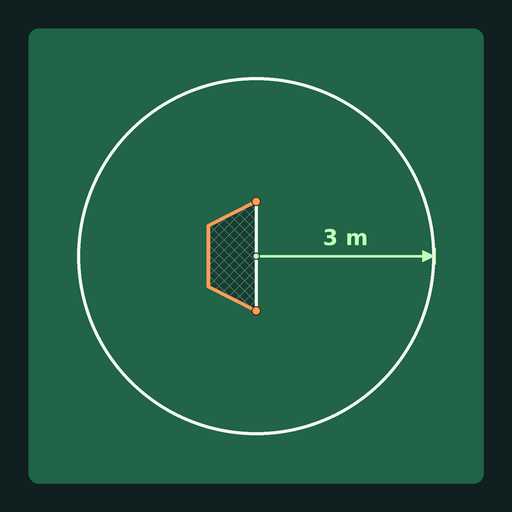
The crease paint counts as part of the crease. That matters when an official checks an attacker’s feet near the cage. On a replay of a close-range shot, look down at the shooter’s feet as well as up at the ball.
Lacrosse Sixes Substitution Area and Field Line Widths
How to mark the substitution area
Set the substitution area between the team benches at midfield. It runs 10 meters along the sideline and 5 meters back from it. Put the timer and scorer’s table on the same side, aligned with midfield and at least 5 meters from the sideline. During play, watch the area just after a team sends the ball upfield. Players can rotate through while the action continues at the far end.
How to lay out a Lacrosse Sixes field on a soccer field
Whether you’re sharing a school field in New York or a park field outside Chicago, walk the site before you stripe it. Check that there’s space for the playing rectangle, benches, table, and substitutions. Then work in this order:
- Set the four corners. Measure the sides and check that both diagonals are equal.
- Mark midfield and the goals. Use the inside edges of the boundaries for the overall footprint, then locate the centerline and both goals.
- Finish with the circles and bench-side markings. Check the official diagram for placement before painting.
For line widths, Appendix A shows a 10-centimeter centerline and 5-centimeter lines elsewhere. The written rule gives a general range of 5 to 10 centimeters and fixes the centerline at 10 and the goal line at 5. Use the appendix for the standard striping layout.
FAQ: Lacrosse Sixes Field Markings for the 2028 Games
How far are Lacrosse Sixes goals from the end line?
About 10 meters, or 10.9 yards. Each half extends 35 meters from midfield to the end line, and the goal sits 25 meters from midfield.
What happens when the ball goes out of bounds in Lacrosse Sixes?
On a loose ball, possession usually goes to the opponent of the player who touched it last. That includes a clean missed shot. If a shot goes out after hitting a post, the crossbar, or the goalkeeper, the offense keeps the ball and the shot clock resets.
What is the center circle used for in Lacrosse Sixes?
It sets player positions for the draw that normally starts each quarter and overtime period. After a goal, play resumes from the net once the goalkeeper retrieves the ball and the official signals the restart.
Where do players enter and exit during a Lacrosse Sixes substitution?
An on-the-fly change goes through the marked area on the bench-side sideline. The incoming player waits until the outgoing player leaves the field. A goalie-for-goalie change takes place on the team’s defensive side of midfield.
What color should Lacrosse Sixes field lines be?
World Lacrosse calls for white or contrasting-colored boundary lines. On shared turf, choose a color that stands out against the surface and the existing stripes so players and officials can pick out the Sixes lines in motion.
Takeaway: How to Read the Lacrosse Sixes Field at the 2028 Games
Start with the 70 × 36-meter rectangle. From there, look for the draw circle to see where a quarter begins, the goal crease to follow close-range play, and the bench-side substitution area to catch changes on the fly.
If you’re laying out a field, work in meters and check where each measurement starts and ends on the paint.
After a save, watch the off-ball movement to see who gets open for the goalkeeper’s first pass.
That’s the thrill of Lacrosse Sixes: a smaller field, a faster game, and nonstop action. Keep your eyes up—because the next big play is always just seconds away!
Ready to unlock your full potential ?